








Snow report for Garmisch-Partenkirchen
Garmisch-Partenkirchen is located in Bavaria, in the German Alps, at the foot of the Wetterstein Mountains. The town sits on the valley floor at about 700 meters, while much higher peaks and cliffs can be seen above the rooftops: the Alpspitze reaches 2.628 meters and the Zugspitze 2.962. During a winter vacation, you can wander from the streets lined with painted houses to the high-altitude slopes, choosing between skiing, hiking, dining, and sightseeing without concentrating your entire stay around a single facility.
The two names recall long-independent towns, still recognizable in the layout of their streets and traditions. Garmisch has a pedestrian zone, squares, and a park; Partenkirchen preserves a succession of inns, shops, and painted facades along Ludwigstraße. For those seeking a vacation where the town plays as important a role as the slopes, this diversity offers much to explore after skiing or during days dedicated to other activities.
The closest ski area to town is the Garmisch-Classic, a 40-kilometer ski area that connects the Hausberg, Kreuzeck, and Alpspitze areas. There are learning slopes, high-altitude red runs, and the black Kandahar runs, linked to the history of international competitions. The Zugspitze, on the other hand, offers a separate, higher ski area, also accessible by cogwheel railway: this is another option during the same stay, not a ski-in ski-out option for the Classic.
Page sections

Discover the best offers for a snow holiday in the best Alpine chalets and huts in the Dolomites, the best facilities immersed in the heart of the Dolomites with typical Alpine style.
The village between painted houses and ancient inns
In Partenkirchen, Ludwigstraße is the place to explore the local architecture. The paintings on the facades, called Lüftlmalerei, depict patron saints and scenes from the life and professions of the owners. Between the houses are small shops and Bavarian inns, perfect for a stroll without having to plan a trip out of town.
In the center of Garmisch, the pedestrian zone leads to Mohrenplatz and Marienplatz. Continuing toward the Loisach River, you reach the oldest parts of the town; Frühlingstraße features farmhouses, some of which are documented as early as the 13th century. Nearby, the old parish church houses 13th-century frescoes. These sights help define Garmisch as a Bavarian village, as well as a ski destination.
The Aschenbrenner Museum, near the Loisach River, displays dolls, porcelain, and nativity scenes. It’s a great indoor visit to complement a stroll through the historic center, especially if you prefer to spend part of the afternoon away from the cold. The painted facades, figures of saints, and wooden carnival masks also showcase a craft tradition still alive in the town.
Garmisch-Classic slopes and facilities
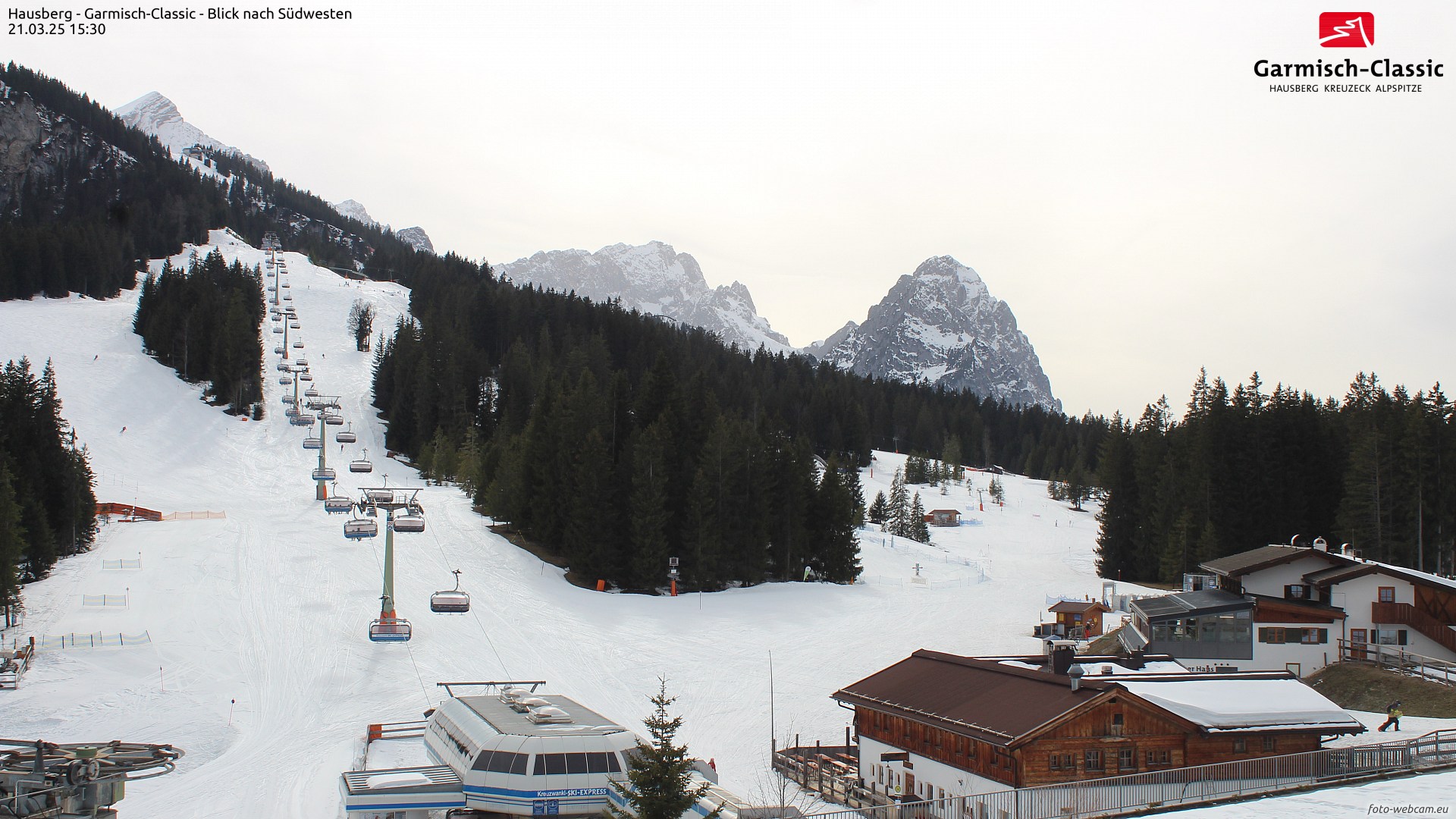
The 40-kilometer Garmisch-Classic includes 12 kilometers of blue runs, 18 kilometers of red runs, and 10 kilometers of black runs. The main departure points are the Hausbergbahn gondola lift, which leads to the Hausberg area, and the Kreuzeckbahn, as well as the Alpspitzbahn cable car. At higher altitudes, chairlifts such as the Kreuzwankl, Kandahar-Express, Hexenkessel, and Längenfelder serve the various slopes and allow you to change areas while skiing.
The ski area rises to the Osterfelderkopf, at 2.057 meters, beneath the Alpspitze mountain. Between the higher runs and the valley floor, both the landscape and the difficulty of the descents change: there are open slopes and longer descents through the forest, with blues concentrated mainly in the upper Hausberg area and reds and blacks continuing downhill.
Hausberg: Learning at altitude and choosing your return
Near the top of the Hausbergbahn is Ixis Kinderland, the introductory skiing area for children. A magic carpet and three beginner lifts serve the practice slope; small slaloms allow for practice turns, while the Funline adds waves, jumps, and a tunnel for those already confident on skis. The four stations of the Beweg dich schlau trail offer exercises and games, with or without skis, following the instructions on the panels.
The blue runs Bayernhaus, Kreuzwankl, and Rimmlermoos offer plenty of room to progress after your first few lessons. It’s important to distinguish these high-altitude runs from the descents back to the village: the Kochelberg is red and the Horn is black. A beginner can therefore ski the upper area and return to the valley by cable car, without having to tackle a more difficult run just because it’s time to go back.
The Skischool Garmisch-Partenkirchen, a ski school located on the Hausberg, offers children’s courses for ages 4 and 5, junior groups for ages 6 to 15, and lessons for adults of all levels. Snowboarding can be learned in a group for ages 8 and up, or with private lessons, also available for skiers. Equipment rental and storage with drying facilities are available at the school and can be booked in advance. Leaving skis and boots at the base avoids having to bring them back to the hotel every evening.
For families, there’s the Kinderland ticket, which includes a ride on the Hausbergbahn and use of the moving walkway in the children’s area. Children under 6 ride the lifts free when traveling with their parents, but a valid pass is still required to attend a ski lesson. Near Kinderland, the Drehmöser 9 and Garmischer Haus restaurants offer children’s menus and allow you to stop for lunch without leaving the learning area.
Kandahar and the slopes for expert skiers
The Kandahar is one of the slopes that made Garmisch-Partenkirchen famous for its competitive skiing. The resort hosted the Alpine World Championships in 1978 and 2011; in preparation for the second edition, the descent was transformed, creating two variants and the section called Freier Fall, where the maximum gradient reaches 92%.
The two black variations, grades 5a and 5b, are 2.920 and 3.330 meters, respectively. They start at 1.690 meters and finish at 770 meters, with a 920-meter elevation gain each, from the top of the Kandahar Express to the base of the Kreuzeckbahn. These descents are for experienced skiers in good physical condition; the accessibility of individual sections should be checked before choosing them, without considering the entire competitive route, which is always available.
For intermediate-level skiing, there are the red slopes Trögl, Hexenkessel, and Olympia. In the highest area, you’ll find Osterfelder, Bernadein, and Längenfelder, also red, beneath the walls of the Alpspitze. Skiing between these areas allows you to explore the area beyond the most famous runs, alternating between high-altitude slopes and forest descents, depending on your skill level.
The Standard-Tonihütte is a ski route, meaning a marked but ungroomed ski trail. Before using it, consider the opening times and snow conditions.
Snow and holiday season
The Garmisch-Classic has artificial snow, fed by two reservoirs that collect rain and spring water. For the 2026/27 winter, the Classic season is scheduled from mid-December to March 29, with openings subject to conditions.
The town’s relatively low altitude allows you to stay in the valley floor and ascend to different areas each morning. For a holiday focused on long descents back to town, however, the status of returns is also important, not just the opening of the upper slopes: the bulletin should be read separately for each area, especially at the beginning and end of the season.
The Zugspitze during a holiday in Garmisch
The Zugspitze ski area offers 20 kilometers of slopes on the Zugspitzplatt, the plateau at around 2.600 meters below the Schneefernerkopf and Wetterwandeck mountains. The landscape is high mountain, very different from the forested slopes of the Classic. The summit, 2.962 meters, is different from the plateau where you ski.
From Garmisch-Partenkirchen, you can take the cogwheel railway, which passes through Grainau and Eibsee before reaching the Zugspitzplatt. Visiting the Zugspitzplatt requires a separate transfer, which must be coordinated with the train and lift schedules. At the top, there are ski schools, rental shops, and restaurants, including Sonnalpin and Gletscher 2600; the rental shop also provides bobsleighs, sleds, and helmets for the toboggan runs.
The 2026/27 ski season is scheduled from November 27th to May 2nd, depending on snow conditions. For those staying in Garmisch in the spring, this option might be worth considering separately from the Classic, which ends earlier.
Views and walks for non-skiers
The Alpspitzbahn cable car allows you to reach the Osterfelderkopf even without skis. Just above the station is AlpspiX, a viewing platform consisting of two 25-meter-long intersecting walkways, each with glass enclosures at the ends. Ahead, you can see the Wetterstein Mountains, and below, the Höllental Valley, about 1.000 meters below.
This high-altitude excursion is also possible in winter, and can be combined with a stop at the Osterfelder 2000 restaurant at the cable car arrival point. The return journey is via the same lift. For a couple or a group where not everyone skis, it allows you to see the mountains up close without having to ski down a slope or tackle a hike with any elevation gain.
Closer to town are the Kramerplateauweg and Philosophenweg, two winter hikes that are generally cleared of snow. Trail conditions should be checked on site, as cleanliness and passability change with snowfall and ice. Those who prefer snowshoeing can choose an outing with a local guide, who will adapt the route to the participants’ fitness level and the snow conditions.
The Partnach Gorge
The Partnachklamm is the gorge carved by the Partnach River, with high rock walls lining the trail and water flowing beneath visitors. The visit introduces a landscape unlike the open views from the lifts: you enter the mountain, following the course of the stream between the rock faces.
The winter schedule, from October to May, is open from 8:00 am to 6:00 pm, with last admission at 5:30 pm. Closures may occur for safety reasons or weather conditions. Therefore, check opening times before reaching the entrance. Strollers and wheelchairs are not permitted in the gorge: for families with very young children, this is a real limitation to consider when choosing a hike.
Cross-country skiing and skinning trips
Cross-country skiing is practiced on a free local network. The Hausberg trail is easy, while the Kaltenbrunn Nordic Center offers more challenging trails, a snowmaking loop, and a floodlit trail. These are two different options: the former allows you to learn the sport closer to town, while the latter offers options for those seeking a more athletic workout. The opening times of the loops and floodlighting should be checked in the winter program.
Dedicated ski touring evenings are planned in the Garmisch-Classic ski area, starting in mid-January when there’s sufficient snow. On Tuesdays and Thursdays, from 5:00 PM to 10:00 PM, you can ascend from the base of the Hausbergbahn cable car along the marked route via Tonihütte, with the option of stopping at refreshment points open to ski mountaineers, including Drehmöser 9, Kreuzalm, and Kreuzeckhaus.
The authorized descent is the Horn, black run number 2. From Kreuzeck, it can be reached via the Mittlerer Skiweg, number 13, and the Kreuzwankl-Umfahrung, number 9. The other runs are closed for grooming by snow groomers, even those equipped with winches: they cannot be used as alternatives. The lifts remain closed and the trails are not lit, so a headlamp is required.
Another ski tour reaches the Stuibenhütte refuge. You ascend on the Alpspitzbahn, descend the Osterfelder and Bernadein runs to the base of the Bernadein lift, and from there begin the ascent with skins. The return journey uses the ski lift again to re-enter the ski area, then the Olympia or Kandahar runs back down to the valley. This outing should be planned based on your experience, conditions, and lift schedules, and there’s a dedicated ticket available. It’s not a walk in the snow, nor is it a descent suitable for beginners.
Restaurants and hotels with spas
While skiing, the Hausberg offers rest stops close to the slopes and the children’s area: Drehmöser 9 serves pizza, while the Garmischer Haus offers Bavarian cuisine. At the base of the Kreuzeckbahn, Kandahar 2 is a bar where you can stop for coffee and cake after returning. In town, the choice continues between inns in the historic streets and hotel restaurants.
The Wurzelwerk, the restaurant at the boutique Werdenfelserei hotel, serves regional cheeses, fish, vegetables, and local herbs in contemporary cuisine. The hotel, built of wood and located near Garmisch’s Kurpark, offers studios and suites, including family suites. The spa features a heated rooftop pool and saunas: a great option for those who want to stay close to the action of the city center and dedicate part of the afternoon to wellness.
Das Graseck is located approximately 900 meters above the Partnachklamm, amidst meadows and woods at the foot of the Dreitorspitze, a mountain in the Wetterstein range. Access is via the Graseckbahn, the hotel’s cable car; cars remain in the reserved parking areas at the bottom. At the top, there are swimming pools, saunas, and relaxation rooms with mountain views. This location offers a different kind of stay than a stay in the center, and should be chosen considering travel to the village and the ski area.
How to get there and get around
From Munich, you can reach Garmisch-Partenkirchen by regional train or by car along the A95 and then the B2. Those coming from the A7 can continue through the Fern Pass and Ehrwald area, entering Bavaria on the B23. From the south, the B2 arrives via Mittenwald and Klais. In winter, check road conditions and forecasts along your chosen route.
Once in the village, the cogwheel railway also serves the Hausberg and Kreuzeck/Alpspitzbahn stops along the route to Grainau and the Zugspitze. Local buses are available for travel between neighborhoods: the municipal service currently operates lines 321, 322, 324, and 325. The location of your accommodation in relation to the stop or station should be considered if you plan to leave your car parked during your holiday.
Airports for Garmisch-Partenkirchen
The nearest airports are Innsbruck, Austria, approximately 62 kilometers away, Munich approximately 123 kilometers away, and Memmingen approximately 134 kilometers away. Innsbruck is closer in terms of distance, while Munich allows you to combine the airport connection with the regional train to Garmisch-Partenkirchen from the city.
From Munich Airport, the S1 and S8 suburban train lines reach Hauptbahnhof, the main train station, in about 40 minutes under normal conditions. There, you’ll transfer to the regional train to Garmisch-Partenkirchen. The total journey time therefore includes this second journey and connections; before booking your flight, check the timetable for the local station.


There are no comments