







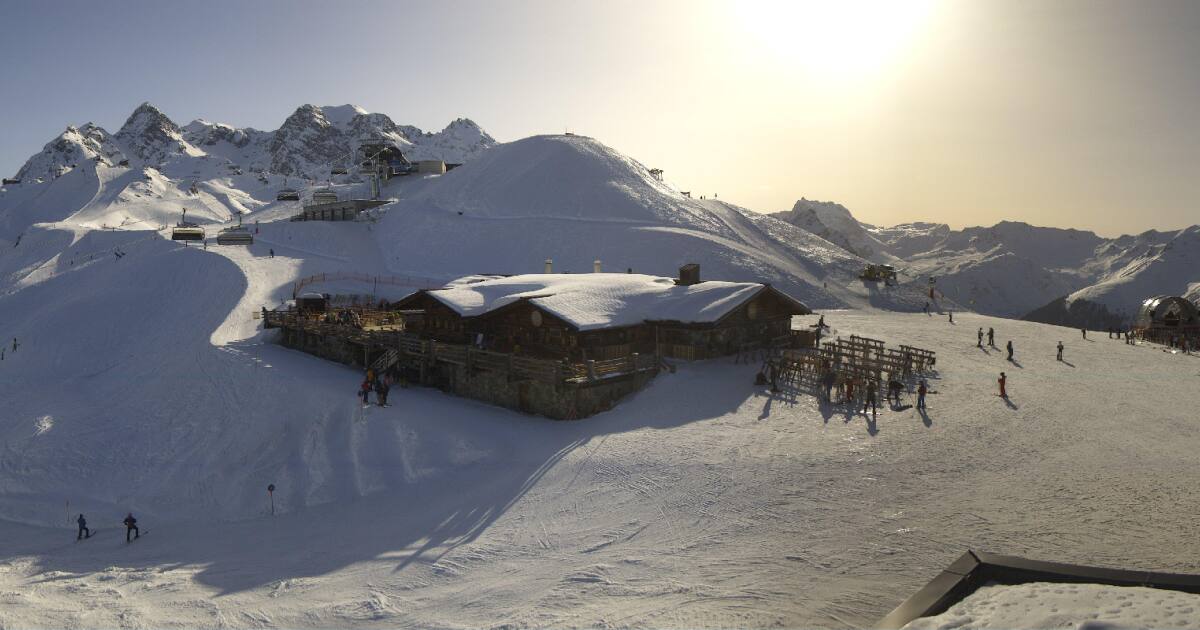
In Vorarlberg, in the Austrian Alps, the Montafon Valley rises from Bludenz towards the Silvretta mountains, between the Rätikon and Verwall mountain ranges. Along the valley floor are villages inhabited year-round, with historic centers, shops, and hotels; above Schruns, St. Gallenkirch, and Gaschurn lies the Silvretta Montafon, the ski area that connects them with slopes and lifts. Choosing your destination offers a variety of vacation experiences: strolling through the pedestrian-only center of Schruns, staying near the entrances to St. Gallenkirch, or meeting up après-ski in Gaschurn’s bars.
The long return to Schruns crosses the high-altitude valleys and continues through the woods, gradually bringing the slopes closer to the village. The black Black Scorpions slopes require expert skill, while a ski tour connects much of the mountain. With 140 kilometers of slopes, there’s plenty of scope for a vacation where you can explore a variety of slopes, combining skiing with a walk in the snow or a few hours in the villages. Families will find beginners’ areas and schools for children and adults, without having to sacrifice the opportunities offered to more experienced skiers.
Page sections
Where to ski: Hochjoch and Silvretta, between the valley floor and the high mountains
The two major ski areas are Hochjoch and Silvretta, connected by the Grasjoch gondola lift. The resort boasts 35 lifts, reaching a maximum altitude of 2.430 meters. In Schruns, you can reach the resort via the Hochjoch gondola lift or the Zamang lift; St. Gallenkirch offers access via Valisera, Grasjoch, and Garfrescha, while Gaschurn offers the Versettla gondola lift. This distribution allows you to choose accommodations in multiple villages while still accessing the same connected ski area.
St. Gallenkirch occupies a particularly convenient location between the two halves of the ski area. Here, the Grasjoch gondola lift, with its eight-passenger cabins, provides access to the Hochjoch, while the Valisera ascends the Silvretta slope: its ten-passenger cabins, with heated seats, take you from 822 to 2.104 meters. In Gaschurn, the Versettla uses six-passenger cabins. For a family taking their first lessons, knowing where to meet the instructor is especially important: many courses begin at the top, after the ascent, and not next to the village hotel.

Discover the best offers for a snow holiday in the best Alpine chalets and huts in the Dolomites, the best facilities immersed in the heart of the Dolomites with typical Alpine style.
The difference between the altitudes for accommodation and skiing is marked. Schruns is located at 690 meters, St. Gallenkirch at 878, and Gaschurn at 979, while 87% of the slopes are above 1.500 meters and 40% are above 2.000. Artificial snow cannons can cover approximately 80% of the slopes. These are useful features for those who want to ski at high altitude but prefer to spend the rest of the day in a valley village rather than staying near the higher lifts.
The long Hochjoch descentTotal
The HochjochTotale offers a glimpse of the mountain with a roughly 12-kilometer descent from Alpilagrat to the outskirts of Schruns. Initially, it crosses the wide Seetal basin; then the route enters a ski tunnel carved into the rock and passes along the north face of the mountain. Below the upper station of the Hochjoch cable car, the descent changes again, continuing in zigzags through sparse forest to the lower part of the resort, where the valley station is located at 730 meters.
Its appeal also lies in the continuity of the route: you leave the mountain open and arrive close to the houses, with the landscape changing as you ski. When tackling it, you need to consider the overall length, especially if you’re used to short descents or are traveling with children who are gaining independence. Before starting from the top, check that the entire return route to the valley is open.
The Black Scorpions and the Montafon Totale Ski
The Black Scorpions comprise some of the most challenging black runs in the area. Run No. 44 is 2.874 meters long, with a 455-meter vertical drop and a maximum gradient of 59%; black runs Nos. 5 and 65 reach 67%. Here, the choice is for steep descents, requiring good ski skills and taking snow conditions into account. The percentages describe the steepest sections, not the constant gradient of the entire run.
To expand your skiing experience to include different areas, there’s the Montafon Totale Ski, a ski tour of slopes and lifts. The circuit includes 45 kilometers of slopes, 20 lifts, and a total descent of 10.000 meters, reaching a height of 2.430 meters. The Hochjoch and Versettla valley stations are the recommended access points, but you can also access the circuit from the other lifts ascending from the valley floor. The Black Scorpions are an optional variant.
This is a tour for experienced skiers interested in exploring the area rather than repeating the same runs. The length of the circuit requires time: before starting, it’s important to check which lifts are open and the return times. This is a ski tour with lifts, distinct from ski mountaineering excursions.
First lessons at altitude and services for children
At Hochjoch, the introductory ski areas include the Kapell travelator and the Jäger and Kapell lifts; in the Nova section of the ski area, there’s the Vallüla Lift and another travelator. These are the places to start before tackling the longer runs. The Schruns Ski School meets next to the Hochjoch and Zamang mountain stations, so you’ll need to take the lift up to meet the instructor.
The Flockenflitzer introductory course welcomes children aged 3 and up, while group lessons begin at age 4. The school recommends snowboarding at around 8 years old. Instruction is available in Italian, as well as German, English, French, and Dutch: a useful feature when children are taking their first lessons abroad. Local schools also offer courses for adults, from beginners to advanced skiers.
In Gaschurn, the Gaschurn-Partenen Ski School offers a children’s course in the Kinderland for children aged 3 and up, as well as private or group skiing and snowboarding lessons. Its offerings include activities for people with disabilities and programs dedicated to cross-country skiing, snowshoeing, freeriding, and ski mountaineering.
For children who don’t ski, there’s the SiMo Gagla Club, a childcare service in Schruns, on the first floor of building M8. It welcomes children ages 3 to 10, including guests of tourist facilities, subject to availability. It’s open on weekends and during some school holidays; for the 2026/27 season, weekends are from December 12th to April 11th. Reservations must be made by 12:00 noon two days in advance, and spaces are limited. It’s an alternative to spending time on the slopes, and should be arranged before arrival.
Snowboarding, freeride and ski mountaineering
The Montafon Snowpark is located on the Grasjoch, on a sunny slope. It features jumps, rails, and boxes-bars and structures to slide down-with options for beginners, intermediates, and experts. In the same area, the Freeride Cross is an 800-meter descent, served by the Freda chairlift, which combines elements of ski and snowboard cross with natural obstacles.
For off-piste skiers, the meeting and information point is the Freeride Station, at the top of the Grasjoch gondola lift. The nearby Zamangspitze, a popular peak for freeriders, features steep slopes, open spaces, gullies, and rock faces. There’s also a permanent training camp at Grasjoch for practicing avalanche transceivers (ARTVAs); device checkpoints are located at the upper stations of Grasjoch, Hochalpila, Versettla, and Rinderhütten.
The valley’s ski schools and guides are the best place to choose an excursion suited to your experience and the current snow conditions. Off-piste skiing requires an assessment of conditions, self-rescue equipment, and the ability to use it. Wildlife quiet zones should also be respected, avoiding crossing dense forests.
Those who prefer to skin up can contact Bergführer Montafon, the local guide organization. Their offerings include easy trips tailored to the group and the day’s conditions, aimed at athletes with some experience or those just getting back into ski mountaineering. Before each outing, check the weather forecast and avalanche bulletin; avalanche transceivers, shovels, and probes are essential equipment. The ski resort’s slopes are not open outside of operating hours, when preparation and safety measures are carried out.
Panoramas and walks in the snow for those who don’t ski
Even without skis, you can reach the highest altitudes: the Hochalpila lift takes pedestrians up to 2.430 meters, while the Panorama gondola lift ascends to 2.375 meters. To combine the ascent with a short hike, there’s the Grasjoch winter trail, which begins at the Grasjoch Hütte refuge and returns to the same point after about 1 kilometer. The loop is easy, with 65 meters of ascent and the same amount of descent, and takes approximately half an hour.
Access is from St. Gallenkirch via the Grasjoch cable car. Suitable footwear for the hike is required; poles and crampons may be useful depending on the terrain. The short route allows for a leisurely stop at altitude, without having to plan a long hike, but preparation and weather conditions should be checked before the ascent.
Above Schruns, the Wang route offers a snowshoe hike. It starts from the Hochjoch and Zamang mountain stations and continues towards Kropfen, below the Sennigrat lift, before returning along the same trail. It’s an easy 1,6-kilometer hike with about 100 meters of elevation gain, and should take about an hour. Along the way, you can stop at the Kapellrestaurant or the Hanglage, two local restaurants.
Sledding
The Kapell natural run starts at the upper station of the Hochjoch cable car and descends for 5 kilometers. It opens when there’s sufficient snow and offers refreshments at the Kapellrestaurant and the Gasthaus Kropfen. In St. Gallenkirch, the Garfrescha lift takes you up to the start of the Garfrescha toboggan run: 5,5 kilometers of slopes are floodlit for nighttime descents and are suitable for experienced tobogganers. This difficulty level, as well as the actual opening times, should be considered before choosing an evening out with children.
Cross-country skiing between Gaschurn and Partenen
On the valley floor, between Gaschurn and Partenen, the Rifabecken loop runs around the Rifa basin. The easy trail, 1,29 kilometers long with a 30-meter elevation gain, is shaded and equipped with lighting. Its compact size makes it a good option for getting closer to cross-country skiing or dedicating part of the day to it, separate from the resort’s slopes.
The entire Montafon Valley boasts approximately 90 kilometers of trails for both classic and skate skiing, with free access to the valley’s slopes. Grooming depends on the presence of a sufficient snow layer and weather conditions; the updated bulletin lists the available trails. To choose where to go, it’s therefore important to check the cross-country ski trails’ opening times, as well as those of the alpine ski lifts.
Villages, Montafon cuisine and wellness
In Schruns, the pedestrianized historic center is home to shops selling local products, crafts, cafés, and restaurants. The stroll along the Litz River offers another opportunity to get out without hiking up the mountains. The Montafoner Heimatmuseum, the local history museum, is located in the church square. Its rooms display shops and domestic environments, including a kitchen, a dairy, and a schoolroom. This visit offers insights into life in the valley beyond its tourism history; check the museum’s winter calendar.
One of the specialties to look for at the table is Sura Kees, a cheese made from acidified skim milk, heated, drained, and then salted and aged. It’s eaten with potatoes and in Keesknöpfli, or in contemporary dishes at Montafon restaurants. Higher up, Valisera Hüsli, near the top of the Valisera cable car, offers Austrian cuisine and Vorarlberg specialties in a rustic setting.
About 2.000 meters above Gaschurn, near the top of the Versettla, the VINNOVA wine bar pairs Alpine tapas made with local ingredients with a terrace overlooking the Heimspitze peak. Back in town, near the base of the same gondola lift is Alte Talstation, the après-ski spot with DJs. Upstairs, the Die Schmelzerei restaurant offers fondue, so you can continue the evening at the table.
For a wellness break, the Sporthotel Silvretta Montafon in Gaschurn hosts the Gold Spa, with 2.000 square meters, a pool, saunas, and relaxation areas. Children’s areas and non-nudist areas are also available. Daily access is available to external guests upon reservation, so you can enjoy this experience even if you’re staying at another hotel, by arranging admission in advance.
When to go and how to get there
The general calendar for winter 2026/27 runs from November 27, 2026, to April 11, 2027, with possible earlier openings depending on snow conditions. The facilities open gradually: for a stay at the beginning of the season or in spring, it’s worth checking which areas and slopes are open, especially if your holiday involves a ski tour or a long return trip to the village.
By train, you can reach Bludenz and continue on the Montafonerbahn, the valley railway, to Schruns. Trains run approximately every half hour, hourly in the evenings, and the Hochjoch cable car is within walking distance from the Schruns station. Buses complete the journey to other villages. Those arriving by car will find the main parking lots at the valley stations; at Valisera, in St. Gallenkirch, a covered paid parking lot is available during the winter.
The reference airports
To arrive from abroad, you can consider Zurich, Innsbruck, Friedrichshafen, Memmingen, Altenrhein, and Munich, comparing flights with transfers to your chosen destination. From Zurich Airport, the train route passes through Zurich Central Station and Bludenz, then continues on the Montafonerbahn to Schruns. For accommodations in St. Gallenkirch or Gaschurn, a bus connection is required: it’s helpful to also check this last leg of the journey when choosing your flight, especially for evening arrivals.


There are no comments