





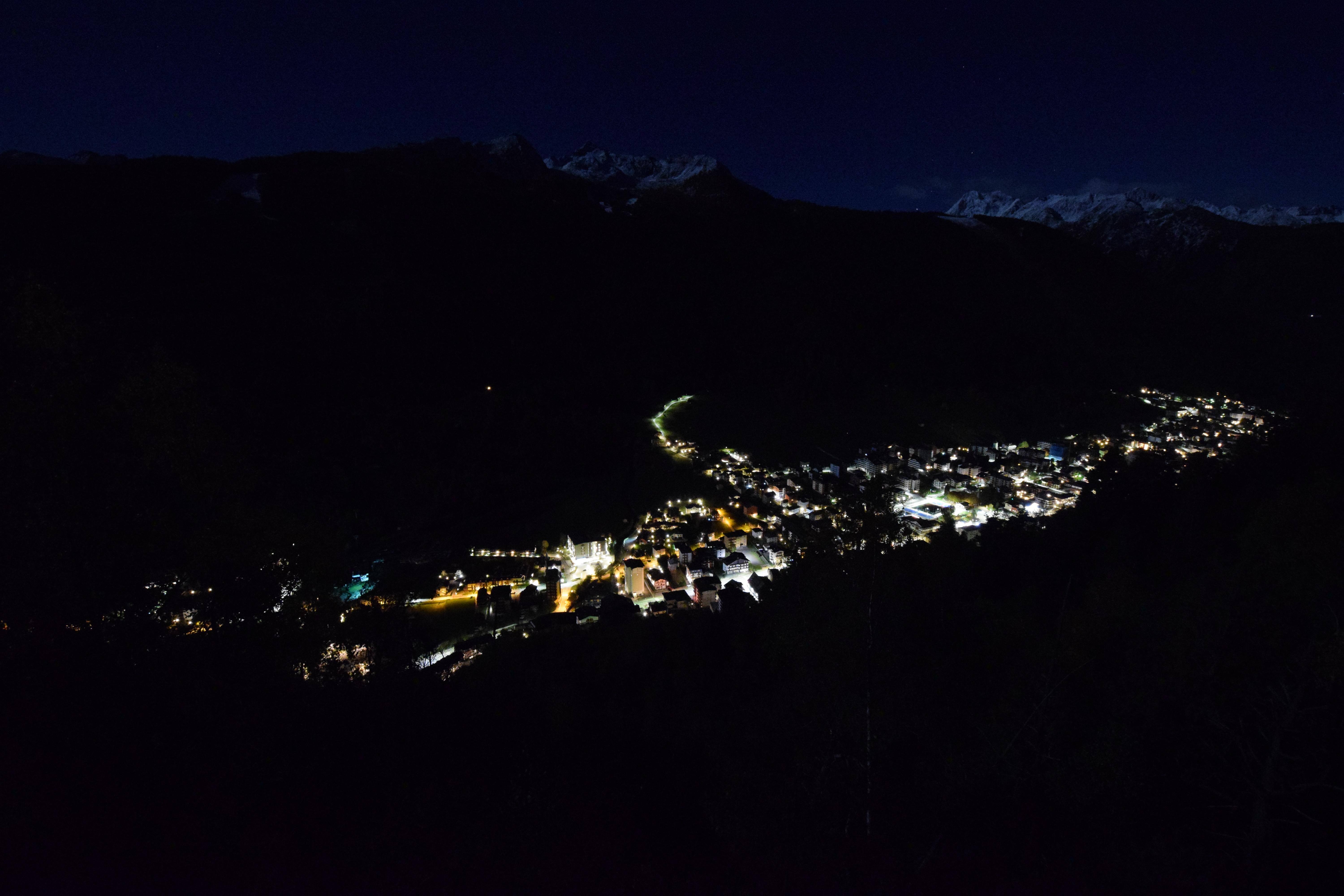
Aprica is located in Lombardy, northern Italy, in the Orobie Alps: the town occupies the pass that connects Valtellina with Val Camonica, at approximately 1.180 meters. The slopes descend right down to the houses, while the cable car departure points and the Campetti, the ski initiation area, are part of the town’s life. The mountains don’t remain in the background of your holiday: just look above the hotels to recognize the slopes and woods where you’ll be skiing.
This direct connection between the town and the slopes is one of the reasons to choose Aprica, especially when traveling with children or learning to ski. Initial lessons close to the house are followed by increasingly longer runs, up to runs starting at over 2.200 meters. Experienced skiers will also find challenging black slopes, with successive steep walls, and can ski between the Palabione, Magnolta, and Baradello areas.
The journey continues in the districts, the oldest parts of the town, where murals depict animals, flowers, and mountain traditions. Just outside the town, the Pian di Gembro Nature Reserve offers a landscape far removed from the slopes: a peat bog surrounded by woods, snowshoe trails, and a cross-country ski loop. Aprica thus lends itself to a vacation where you can devote ample time to skiing, but also leave a morning free for walking in the snow or lingering over a meal.
Page sections
Where to ski in Aprica: from the Campetti to the high-altitude slopes
The Aprica ski area offers approximately 50 kilometers of slopes. The three main areas-Palabione, Magnolta, and Baradello-are connected; additionally, there are the Campetti (small ski areas) in the town. The main access points are the Palabione and Magnolta gondolas and the Baradello chairlift. Higher up, there are chairlifts and drag lifts, while the introductory slopes also feature moving walkways.

Discover the best offers for a snow holiday in the best Alpine chalets and huts in the Dolomites, the best facilities immersed in the heart of the Dolomites with typical Alpine style.
Learning to ski, even as an adult
At Campetti, you begin with short, gently sloping slopes, served by travelators, ski lifts, and the Alpe Vago chairlift. It’s close to the town’s amenities, including schools and snow playgrounds.
Lessons aren’t just for children. The Aprica Italian Ski & Snowboard School and the GB Ski School offer individual and group courses, from beginners to advanced, including for adults. Snowboarding lessons are available for those who prefer snowboarding; GB also organizes the GB Snowboard Project, a seasonal program for children and teens who want to continue their training.
Easy runs include the Baradello Superpanoramica, a blue run, and the Piana dei Galli in Magnolta, a blue run. However, the length of the runs and the return journey must be considered along with the difficulty: an easy run of several kilometers requires more autonomy than a short practice slope.
Palabione, the highest slopes and the returns to the woods
Palabione is the central area of the ski resort. The cable car departs from the village and takes you to approximately 1.700 meters; from there, the Quadrifoglio chairlift and the Dosso Pasò ski lift provide access to the upper slopes. The ski lift reaches 2.270 meters, the highest point of the ski area, where the view opens up over Aprica.
Here you’ll find the red Dosso Pasò Valletta run and the black Benedetti. The latter is one of the descents to master for more challenging skiing: the run descends from 2.255 to 1.475 meters, for a vertical drop of 780 meters, with a maximum gradient of 52%. Lower down, the Lago Palabione run is a red run, while the descents back to the village pass through the forest and still require good ski control: the red runs continue well beyond the higher-altitude runs.
Next to Palabione’s B and C entrances is the Alpine Eco-Fauna Observatory, a natural area where ibex and chamois roam in semi-freedom. From the slopes, you may spot them near the fence. This is a unique feature of these descents, distinct from the guided tour of the Observatory, which takes place during the summer months.
Magnolta, the Piana dei Galli and the Pistone
In Magnolta, the 10-passenger cable car ascends from the village to the slopes and refreshment areas. The Piana dei Galli chairlift continues up to just over 2.000 meters, serving the blue run of the same name. Lower down are the red runs Puncera and Roccolo, so you can stay on intermediate-difficulty runs before opting for the more challenging return.
The Magnolta Inferiore is the black run that skiers call Pistone. It descends to the village for about 2 kilometers and a 500-meter vertical drop, with three closely spaced walls. The breaks between the steep sections are short, and the descent requires consistency, especially when you begin to feel fatigued. It also receives little sun, a characteristic to consider when considering snow conditions.
Magnolta and Palabione are connected at altitude by the Granvia del Gallo cable car, which operates in both directions. This allows you to change areas without having to go down to the village and take another cable car. To return to your chosen access point in the morning, you must respect the closing times of the lifts and connections.
Baradello, the Superpanoramica and evening skiing
Baradello is reached by the chairlift that departs from the San Pietro area and ascends to about 2.000 meters. Its most famous descent is the Superpanoramica: a blue run about 6 kilometers long, offering views of Aprica, Valtellina, and the Rhaetian Alps. The chairlift’s mid-station allows you to return without having to hike the entire way back down each time.
On this side, there’s also the Direttissima Inferiore, a black run. The Superpanoramica doesn’t exhaust the Baradello’s possibilities, but it remains the most natural choice for those seeking a longer, less demanding descent. At the chairlift’s top station, you’ll find the Chalet Dal Brusca, a refuge where you can stay at high altitude.
The Superpanoramica is illuminated along the route, and on alpine skiing evenings, you can return to skiing after sunset. Ski mountaineering and snowshoeing evenings, however, have their own rules: in those cases, the illuminated trail is used for ascents on foot or with skins. Choose the appropriate time for your desired activity, checking the season calendar.
Snow, altitudes and the choice of season
Between the Campetti, at around 1.200 meters, and the top of the Dosso Pasò ski lift, there’s a difference in altitude of over 1.000 meters. A significant portion of the skiing takes place in the forest, while the higher runs lead to open slopes. Artificial snowmaking covers almost the entire area and also includes numerous return runs: it’s not limited to the higher slopes.
For a winter vacation with small children, you can choose accommodation near the Campetti and arrange lessons at the village level. Those looking for longer slopes should consider the opening hours of the return routes, in addition to those of the upper lifts. At the beginning of the season and in spring, the Aprica bulletin lists the individual slopes available: it’s the reference point to check before booking a short ski trip, along with the weather forecast.
Snowshoeing and cross-country skiing at Pian di Gembro
Walking in the woods starting from Aprica
The Sentiero del Bosco Gentile (Gentle Woods Trail) is one of the winter trails that begins directly in the village, near the Magnolta cable car station. The loop is 4,8 kilometers long and takes about two hours to complete: from an initial elevation of 1.213 meters, it climbs to 1.485 meters, passing through the forest and the mountain huts of Corna Alta. Along the way, views of the Valtellina and the Rhaetian Alps open up.
It’s an easy route, but with a significant climb, so consider the children’s age and walking habits. Signs created by students from Aprica’s elementary school provide hiking tips and a connection to the village. Snowshoes are used in fresh snow; ground conditions may require different equipment, which should be chosen before departure.
The reserve and the ring for the bottom
Pian di Gembro is located above Aprica, at approximately 1.350 meters. The reserve’s landscape revolves around peat bogs, with large flat stretches at the edge of the forest and views of the Adamello mountain range. For snowshoeing, there’s the 4,8-kilometer loop trail through the nature reserve, which passes by the little church of San Fortunato; other trails extend toward Piscè and the surrounding mountain huts.
Cross-country skiing is practiced on an easy, approximately 3-kilometer loop, prepared for both classic and skating techniques. The moderate elevation gain makes it suitable for beginners. Access is close to the road, and equipment rentals are available. For a break, along the road to Trivigno, you’ll find the Cascina Biancotti restaurant in the Pian di Gembro area.
Snowshoe trails and cross-country ski trails must be respected for their distinct uses. Before reaching the reserve, it’s a good idea to check the grooming of the trail and the condition of the trails: here, a snow holiday depends on natural snowfall, not just the opening of the alpine ski area.
Ski mountaineering towards Mount Padrio
Trivigno, the mountain village reached beyond Pian di Gembro, is the starting point for the ascent of Mount Padrio on ski mountaineering skis. The route ranges from 1.792 to 2.150 meters, with a difference in altitude of approximately 360 meters; the ascent takes approximately 1 hours. The gentle slopes and the route through mountain huts and open spaces make it an easy-to-medium hike, with expansive views of the surrounding mountains and valleys from the summit.
The descent follows the ascent route and takes place off the ski slopes. It requires the ability to assess snow conditions, consult the snow and weather forecast, and have self-rescue equipment-ARTVA, shovel, and probe-and the proper use. To learn ski mountaineering or choose an outing based on conditions, you can contact the Alpine Guides of the Orobie Valtellinesi Park. Evening skinning sessions at the Superpanoramica are a separate option, regulated by the Baradello calendar.
The town, museums, and activities for non-skiers
Corso Roma runs through Aprica and is home to shops, bars, and services, but to get to know the town, it’s worth exploring its districts. At Dosso, the highest point, Alcide Pancot’s murals depict Alpine flora; in San Pietro, they depict animals, while in Santa Maria, scenes from local history and traditions appear. Fountains, churches, and adjacent houses illustrate the town that grew up around the pass, along with the holiday homes.
In winter, you can ice skate in Piazza delle Sei Contrade, with skate rentals available on site. This activity is close to the city center and can be combined with a stroll without planning a hike. Opening hours depend on the winter calendar and weather conditions, including evenings.
The history of skiing and nature to be discovered indoors
The Ski and Mountain Museum, located at Corso Roma 150, houses the collection started by Elio Negri. From wooden skis from 1890, the exhibits move to 20th-century models and modern racing equipment. Among the exhibits are the skis of Zeno Colò, an Olympic alpine skiing champion. It’s a visit inspired by what you see on the slopes, but also accessible to those who have never skied: materials, bindings, and shapes demonstrate how much the way of skiing has changed.
The same business center is home to the Gallery of Emotions in Nature, an indoor exhibition featuring reconstructions of Alpine environments. Visitors will encounter the legendary Homo Selvadego, a living anthill, a trout pond, and the environments of a mine and a cave. Guided tours, available by reservation, allow visitors to explore details that will also interest children, such as the underground cells of the anthill and the marmot burrows recreated in the Alpine landscape.
At the table and in the hotel
The holiday cuisine is typical of the Valtellina region. Pizzoccheri combine buckwheat pasta, potatoes, cabbage, Casera cheese, and butter; sciatt are buckwheat fritters filled with cheese. Aprica even has its own dessert, panvì, made with slices of rye bread toasted in butter and sprinkled with red wine and sugar.
For dinner in town, Ristorante Barbasch by Gimmy’s on Via Valtellina offers fresh pasta and mountain dishes, including pizzoccheri. For an aperitivo, Grizzly Bar on Via Adamello serves draft beer and is located near the Palabione ski area. On the slopes, you can stop at the refreshment points in the three ski areas without having to return to the town center each time.
When choosing accommodation, proximity to the Campetti ski slopes can be particularly helpful for families, while those wanting to start skiing on the high-altitude slopes can opt for one of the main departure points. The Cristallo Wellness Hotel, near the Baradello ski lifts, offers a kids’ club with dedicated staff and hours, as well as ski and boot storage. For wellness, it features a sauna, Turkish bath, a hot tub, and a pool under a glass roof, offering views of the surrounding landscape. Access to the wellness area and treatments must be verified in the booking package, as they may incur a surcharge.
How to get to Aprica
By car, you can reach it from the Valtellina side via the SS36 to Piantedo, the SS38 to Tresenda, and finally the SS39 to the Aprica Pass. From the Val Camonica side, reach Edolo and ascend along the SS39. The pass road passes through the town: it is not closed to traffic.
By public transportation, you can take the Milan-Sondrio-Tirano railway and continue by bus from Sondrio or Tresenda. Alternatively, the Brescia-Edolo railway line combines with a bus to Aprica. When choosing your route, it’s a good idea to check the entire route to the town, especially for the last arrival in the evening.
Airports for a holiday in Aprica
The nearest airports are Bergamo Orio al Serio, about 120 kilometers away, Milan Linate, about 170 kilometers away, and Milan Malpensa, about 200 kilometers away. Bergamo provides access from Val Camonica; from Milan’s airports, you can continue to Milan and take the train to Valtellina, completing the journey by bus.
A private transfer or rental car avoids the hassle of changing luggage and equipment, while public transportation requires you to time your flight, train, and the final ride to Aprica. In winter, it’s a good idea to allow for road conditions on the climb to the pass.


There are no comments