









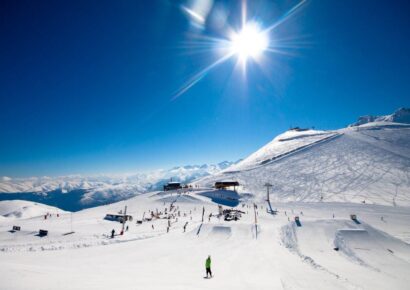
Cerler is located in Spain, in Aragon, in the province of Huesca, in the central Pyrenees mountains. The town sits at 1.540 meters above the Benasque Valley and retains a small historic center centered around the church of San Lorenzo. Stone, wood, and slate roofs tell a story that predates the ski resorts; just beyond the houses lies the ski area, which ascends toward the Gallinero mountain and its views of the great Pyrenean peaks.
The mountains are the main reason to come here. From the upper part of the resort, you can see Aneto, the highest peak in the Pyrenees at 3.404 meters, Posets, and Perdiguero. The runs traverse open slopes and forests, with descents long enough to change scenery before the next ascent. The most famous, Cerler 9Km, connects an altitude of 2.630 meters with the finish near the village, at 1.500 meters.
This variety appeals to those who want to ski for several days, but the holiday also offers another option: staying on the snow without dedicating yourself to downhill skiing. In Ampriu, there are sleds, a marked snowshoe trail, and terraces accessible from the parking lot; in the Benasque Valley, you can add a day of cross-country skiing in Llanos del Hospital. Cerler remains the base for alpine skiing, while excursions in the valley require a trip and allow you to experience other landscapes.
Page sections
The Cerler slopes, from El Molino to Gallinero
The resort boasts 81 kilometers of slopes ranging from 1.500 to 2.630 meters. The 74 trails include 10 green runs, 20 blue runs, 29 red runs, and 15 black runs: there are areas for beginners, as well as a wide selection of runs for intermediate and expert skiers. The 19 facilities include 9 chairlifts-6 four-seater and 3 six-seater-, 4 drag lifts, and 6 conveyor belts. Artificial snowmaking systems cover 46 kilometers of slopes, with 529 snow guns.

Discover the best offers for a snow holiday in the best Alpine chalets and huts in the Dolomites, the best facilities immersed in the heart of the Dolomites with typical Alpine style.
There are two road accesses. Cerler 1.500, also known as El Molino, is located next to the village; from here, the El Molino chairlift ascends to Cota 2.000, a key area for lessons and dining. Continuing along the road, you reach Ampriu 1.900, with a second parking lot, rental shops, schools, and access to the slopes. These are two entrances to the same ski area: your choice may depend on your accommodation, your meeting point with the instructor, or the activities you want to do.
Day and multi-day ski passes are available for Cerler. Those wishing to visit multiple resorts can choose the Aramón 294Km pass, which is also valid for Formigal-Panticosa, Javalambre, and Valdelinares. These are separate ski areas, accessible by road, and not an extension of the Cerler slopes.
The Cerler descent 9km
Cerler 9Km is a 9-kilometer route with a 1.130-meter elevation gain, consisting of several connected trails. It starts in the Gallinero area at 2.630 meters and ends at the Remáscaro restaurant, at the base of Cerler 1.500 meters. The descent takes in trails such as Perdiz Blanca, Colladeta, and Robellóns, leaving the higher slopes behind to get closer to the woods and the village.
It’s a route suitable for intermediate skiers, also interesting for families where the children are already skiing independently.
The Las 4 Cimas ski tour
Those who prefer to explore the area can take a circuit designed by the operator, Las 4 Cimas. It connects blue runs and lifts to Rincón del Cielo, Cogulla, Gallinero, and Collado de Basibé, four high points of the ski area offering diverse mountain views. It starts from the El Molino chairlift and ends in the Ampriu area; the route is available in the itineraries section of the Aramón app.
It’s a ski tour on the slopes, not a skinning excursion. It allows you to explore the different areas by following the blue runs, with a succession of views between Gallinero and Collado de Basibé.
Learning to ski and taking children to the snow
The introductory ski areas are located at Cerler 1.500, Cota 2.000, and Ampriu 1.900. There are specific ski passes for beginners, in addition to the standard ski pass. Schools have meeting points at the various access points: among them are the Escuela Española de Esquí and Equipo Barrabés, which offers ski and snowboard lessons for all ages, from beginners to advanced.
For little ones who already ski, activities don’t stop at the practice slope. At Cota 2.000, the Snowy area includes exercises and skill games along the Puentet and Robellóns runs. The Bosque Encantado, accessible from the Fontanals run, leads into the Swiss pine forest through a path with tunnels and animal-themed surprises. These options can be chosen according to the child’s skill level, accompanied by an instructor or an accompanying adult.
At Ampriu, the Snowy Zone is a snow playground with playhouses and slides, near the terraces and beginner areas. For families requiring assistance, the two Snow Gardens (Jardines de Nieve) are childcare facilities at Cerler 1.500 and Ampriu 1.900, which can be booked separately from lessons. Ampriu welcomes children aged 1 to 6; children under 1 year old can stay for a half-day, up to four hours. Snow games are reserved for children aged 3 and older, while younger children stay indoors. The full-day program includes lunch, and the center provides skis and boots for outdoor activities. The program thus alternates the first contact with the snow with stories, music, and games, without requiring children to spend the entire day on skis.
Snowboarding, parks and play trails
The Cerler Terrain Park is located in the Rincón del Cielo area and has a dedicated lift. The facilities include elements for beginners and lines for advanced riders, with configurations that change throughout the season.
At Ampriu, the Basibé slope gives access to the Boardercross, with its bumps and banked turns, and the Funny Track, a course with obstacles and interactive games. These options are different from the jump park: they add variety to the day, even for those skiing with kids who want to try something beyond the traditional slopes.
Ampriu for those who don’t ski
Ampriu is the easiest place to organize a day on the snow without skis. The terrace with a bar and refreshments is accessible from the parking lot; Ampriu Park features a sledding slope with a magic carpet, games, and a snow carousel. Sleds are provided with access to the dedicated area, so families can participate without bringing their own.
A circular snowshoe trail also starts here: 3 kilometers, 160 meters of elevation gain, and about an hour’s walk, marked with orange and green poles. Snowshoes can be rented at the starting point. The short distance allows you to try this activity without undertaking a long high-altitude hike; trail opening and conditions are listed in the station bulletin.
To enjoy the view, you can purchase a return pedestrian ticket on the Batisielles chairlift, which takes you to the Colladeta terrace. The El Molino chairlift, at the other entrance to the ski area, also transports pedestrians up to Cota 2.000. Those seeking a guided experience other than hiking can also enjoy snowmobile excursions in the Ampriu Valley, which can be booked through the operator.
Cross-country skiing in Llanos del Hospital
Llanos del Hospital is the northern area of the Benasque Valley, within the Posets-Maladeta Natural Park. It is located outside the Cerler ski area: to reach it, you must descend into the valley and continue towards the upper part. The base, near the old Hospital de Benasque, is approximately 1.750 meters above sea level, on the northern side of the Maladeta massif.
From here, over 30 kilometers of cross-country trails begin. Plan del Hospital is the introductory area for children and adults. The Plan de l’Están and Plan de Besurta trails are intermediate in difficulty: the former climbs from 1.750 to 1.950 meters, the latter continues up to 2.100 meters. The mountain pine forests and the park’s mountains give this outing a distinct character from skiing on the Cerler slopes. The area is also ideal for snowshoeing, following the designated trails and avoiding the need to walk on the cross-country ski tracks.
At the base, you can rent classic and skate skis, boots, and children’s equipment, as well as snowshoes and sleds. Access to the Nordic trails requires a day or season pass. The nearby Hotel Hospital de Benasque, with its restaurant and café, allows you to stop for a hot drink or a meal without leaving the upper valley; the learning area begins right next to these facilities.
Ski mountaineering: dedicated routes and great mountains
Within the Cerler ski area, there are four marked routes for skinning. Iniciación is the shortest: 1,2 kilometers and 148 meters of elevation gain, with an easy difficulty level. The Cota 2000 route is 3,2 kilometers and 497 meters of elevation gain, with a moderate difficulty level; Pico Cerler and Rincón del Cielo are classified as difficult. The trail opening status is updated in the snow report.
For those seeking excursions outside the ski areas, the Benasque Valley is also a mountaineering base. Local guides, including Equipo Barrabés, offer ski mountaineering and mountaineering activities: the route and difficulty level are chosen based on experience and conditions. On unmonitored slopes, snow and avalanche assessments, self-rescue equipment, and adequate skills are required; the proximity of the ski lifts makes a marked ascent and a hike in the massif inconsistent.
The village, the places and where to stay
Cerler’s old town deserves time even after skiing. The 16th-century noble homes and older buildings are clustered along streets like Calle del Obispo, which leads to the square. Casa Cornel retains an internal courtyard protected by a portico, an example of the village’s domestic architecture. Cerler’s local name is Sarllé, in Patués, and its origins are documented as early as the 9th century: the old town remained recognizable even after the tourist boom of the 1970s. Today, Casa Cornel is also a hotel, offering family rooms and duplexes on two floors, with a double bedroom downstairs and an attic space with a sofa bed upstairs. Staying in the village allows you to rediscover this architecture when you return from the mountains.
Accommodations also include apartments and hotels closer to the base of the ski lifts. The Evenia Monte Alba is located about 200 meters from the lifts and has a heated swimming pool, covered in the winter, with mountain views. Families can enjoy dedicated rooms, a room with billiards and table football, and an entertainment program: the Mini Club offers games and workshops for children aged 4 and up, while younger children participate with an adult. Accommodation and ski passes can be booked together, picking up the ski pass at reception; the ski storage room allows you to leave your equipment at the hotel upon your return.
Those looking for a hotel with a spa can also consider the SOMMOS Hotel Benasque Spa, in the nearby village of Benasque. It’s a base in the valley, different from a stay in the village of Cerler, and requires a trip to reach the slopes.
During the day, you can eat at El Bosque, a restaurant in the Rincón del Cielo area, or at Parrilla Cota Dosmil, which offers grilled dishes and specialties like longaniza de Graus, a local sausage specialty. The Ampriu terrace is also accessible to non-skiers. On the way back, Remáscaro, near the El Molino chairlift, is the meeting point for après-ski, with a terrace at the base of the slopes.
Sunset at high altitude and dinner among the pine trees
The Skyline program takes skiers and snowboarders to Rincón del Cielo to watch the sunset, stop at the El Bosque pizzeria, and finally descend towards Cerler 1.500 with headlamps provided by the organization. The light on the mountains and the descent after the lifts have closed are the heart of the experience, reserved for those who safely tackle red slopes. Children aged 8 and under can participate, accompanied by an adult if they are under 16, on the scheduled dates and in favorable weather conditions; the day’s ski pass is separate from the activity reservation.
For an evening without skiing, El Bosque also offers dinners with transport in a snowcat equipped with a covered cabin. You ascend from Cerler 1.500 to the restaurant, above 2.000 meters, among the pine trees of the mountain, and return by the same vehicle after dinner. The program includes local cuisine and a children’s menu; reservations and a minimum number of participants are required. It’s a high-altitude dining experience, also suitable for a couple or family who don’t want to brave the nighttime descent.
Airports and how to get to Cerler
To arrive by plane, you can compare Zaragoza, Barcelona-El Prat, and Lleida-Alguaire, depending on available flights from your country. All require a road journey to the Benasque Valley and the final stretch to Cerler: the town has no train station or airport. A rental car or pre-booked transfer makes the journey easier when carrying skis and luggage.
By public transport, Avanza connects the valley with Barcelona and Huesca; there are also connections from Zaragoza and Lleida via Barbastro. Trains run to cities such as Huesca, Lleida, and Zaragoza, from which you must continue by bus or taxi. Transfers from Benasque to your accommodation in Cerler must be arranged separately, depending on available connections during your stay. For those driving, the main access points to the resort have parking lots at Cerler 1.500 and Ampriu 1.900.



There are no comments