









Snow report for Puy-Saint-Vincent
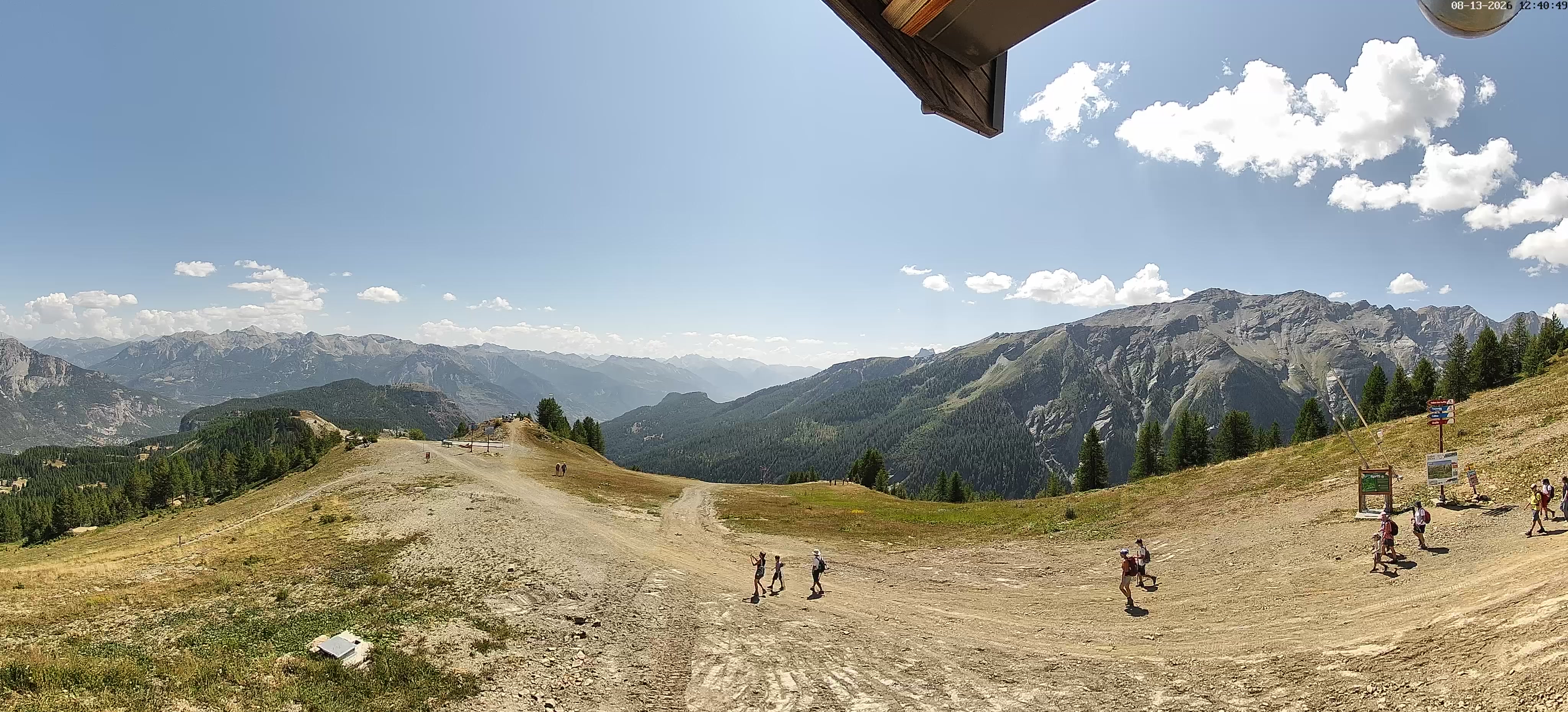
Puy-Saint-Vincent is located in the Hautes-Alpes, in the southern French Alps, above the Vallouise Valley and facing the Écrins massif. The Pelvoux, one of the great mountains in this group, dominates the view from the slopes and open spaces above the village. Among the larches, the small hamlets from which the town grew can still be seen; higher up, the buildings constructed for skiers overlook the ski area.
It’s a destination that combines a comfortable vacation near the ski lifts with challenging skiing. The 75 kilometers of slopes include practice slopes, blue and red runs through forests and high-altitude slopes, as well as ungroomed black runs beneath the Pendine and Rocher Noir. The variety of runs allows you to stay for several days without limiting yourself to repeating the slope in front of your accommodation, while cross-country skiing and snowshoe trails allow you to explore another side of the mountain.
To choose where to stay, you must first choose between Puy-Saint-Vincent 1400, 1600, and 1800: the numbers indicate the three levels of the resort, which share the slopes but offer different environments and services. The historic village remains at the bottom; at 1.600 meters, activities and accommodations close to the ski lifts are concentrated, while at 1.800 meters, residences and apartments overlooking the Écrins prevail.
Page sections

Discover the best offers for a snow holiday in the best Alpine chalets and huts in the Dolomites, the best facilities immersed in the heart of the Dolomites with typical Alpine style.
The country and the three levels of the station
Puy-Saint-Vincent 1400 is home to the villages of Le Puy, Les Alberts, and Les Prés, with houses, wooden chalets, chapels, and quiet streets. This is the area to consider if you prefer to stay in a mountain village while still having access to the ski lifts. Accommodation options include small hotels, chalets, and apartments; essential shops include groceries, bakeries, and rental shops, as well as restaurants.
Les Prés is also the starting point of the Télécombi Les Prés, a lift that alternates between cabins and chairs on the same route. It connects the 1400-meter area to the mountain above and is important for both skiers and for access to the Nordic area. Proximity to its starting point is more important than the “1400” in the accommodation address: the various units do not all coincide with the slopes.
Puy-Saint-Vincent 1600, on the other hand, has grown around skiing, with residences, apartments, and services clustered near the ski lifts. Here, you’ll find ski schools, bars, restaurants, shops, and the Le Panoramic leisure complex. For a family planning morning lessons and afternoon indoor activities, having these nearby attractions can simplify their stay. The architecture and layout are those of a tourist resort, distinct from the narrow streets of the village below.
The 1800-square-meter core is home to mostly holiday homes, apartments, and chalets, in a quieter setting than the 1600-square-meter center. Winter ski buses connect the three levels, allowing you to reach the other cores without having to move your car every time.
Slopes and facilities, from the forest to Pendine
The Puy-Saint-Vincent ski area extends between 1.400 and 2.750 meters, with 35 slopes and 11 ski lifts. Over half of the area is above 2.000 meters, and the prevailing exposure is north and northwest: conditions favorable for snow retention, to which artificial snowmaking is added.
From 1600 meters, the Crête des Bans and Bergerie chairlifts provide access to the ski area. The former reaches approximately 2.280 meters, the latter just over 2.100 meters; both are automatic detachable. Higher up, the Pendine, Rocher Noir, Lauzes, and Bruyères lifts continue. The runs pass from the open slopes of the upper section to the larch forests through which many of the descents to the accommodations take place.
The blue Les Crêtes trail follows the contours and continues toward the forest, while the red Draille offers another descent on the same part of the mountain. The red Bergerie leads back to the residential area at 1600 meters; descending to the lower level, the blue Granges and red Vergnes are two landmarks for reaching the 1400 meter area. The blue and red alternatives allow you to choose your return route based on your ability.
The Vallouise blue run requires a different choice: it descends lower and the return to the resort is by shuttle. Before taking it, it’s therefore important to know the planned return connection.
The first descents and ski schools
The introductory ski areas are located at 1400 and 1600 meters, where beginners can familiarize themselves with their skis on dedicated slopes. At 1600 meters, the Crapahute conveyor belt is free: it allows you to repeat your first ascents without having to immediately use the lifts that go up to the upper part of the resort.
The ESF, the French ski school in Puy-Saint-Vincent, organizes the Piou Piou Club for children aged 3 to 5, as well as courses for those aged 6 to 13 and lessons for teens and adults. Snowboarding can be learned from age 7; private lessons, telemark skiing, and handiskiing are also available. Handiskiing uses adapted equipment, under the guidance of an instructor, to allow disabled skiers to ski. The ESI, the resort’s international ski school, limits group classes to eight students and offers a snow garden for children aged 3 and up.
Childcare is separate from classes. Daycare centers and daycare services cater to children aged 3 to 6 at both 14:00 and 16:00; the mini club for children aged 6 to 12 is only available at 16:00. A family wishing to combine classes and childcare must therefore organize their bookings, taking into account the location of the two activities.
The ungroomed blacks and the skiing in the upper part
The Pendine chairlift reaches 2.667 meters, below the peak of the same name, which is approximately 2.750 meters high. On this side are the red Grande Combe and the black Pendine and Carmen. The Rocher Noir, the peak served by the chairlift of the same name, offers another black run of the same name.
Pendine, Carmen, and Rocher Noir are ungroomed. Their appeal for expert skiers lies in the ungroomed snow: they’re not black, so you wouldn’t expect a smooth surface, and require a technique suited to the conditions encountered. In the upper section, there are also blue runs, including Dahu and Rhodos, so climbing to altitude doesn’t force everyone to use the more difficult runs.
For snowboarders, the snowpark adds jumps, rails, and other features, while the boardercross area offers banked turns and bumps. These areas are different from the resort’s regular slopes; the choice of features and obstacles should be tailored to your skill level. The resort’s schools offer snowboard and freestyle lessons, in addition to ski lessons.
During the French school holidays, you can also ski in the evening on a 2,7-kilometer floodlit slope, accessible from the Télécombi Les Prés at 1400 meters. For the 2026/27 winter season, opening hours are planned on Tuesdays from 5:15 pm to 7:00 pm during the Christmas and February periods. Access is included for those with a ski pass valid for one day or more; otherwise, an evening ticket is available.
Cross-country skiing between Tournoux and the Têtes viewpoint
The Nordic area occupies an environment of larch trees, clearings, and scenic spots, with trails for both classic and skating techniques. Snow here is naturally occurring, and opening times depend on site conditions. The reference point is the Nordic chalet, where passes are purchased and information on the trails is available: from the village at 1400 meters, the Les Prés lift is used, while from 1600 meters and 1800 meters, shared access routes of approximately 1 and 1,5 kilometers, respectively.
The Tournoux-La Rochaille route is approximately 3,5 kilometers round trip from the Nordic chalet, with a 45-meter climb. It passes through a larch forest and the small village of Tournoux, offering views of the Pelvoux.
For experienced cross-country skiers, the Belvédère des Têtes circuit is about 10 kilometers long and reaches an altitude of 2.020 meters. It passes the Petites Têtes and Grandes Têtes, ascends through the forest, and returns through the Col de la Pousterle area. It’s a more challenging route, with climbs and descents requiring good command of narrow skis.
The cross-country trails are reserved for skiers and require a fee; dogs are not allowed. In March, when some sections receive the sun first, morning is the best time to practice. Once the site closes at 4:30 PM, you cannot continue on the trails independently: snow preparation begins.
Snowshoeing and snow walks
Non-skiers can explore the landscape by following the walking and snowshoe trails, staying on dedicated and shared paths without using the cross-country ski tracks. From the Nordic chalet, you can reach vantage points offering views of the Pelvoux, the Glacier Blanc (a glacier in the Écrins massif), and the Durance Valley.
The Col de la Pousterle route is approximately 5,6 kilometers round trip and 175 meters of climbing. It is marked and well-trodden and reaches the Pelvoux and Fournel viewpoints. It is classified as medium difficulty: it may be suitable for a family accustomed to hiking, with active children aged 10 and up, but should not be confused with a short, flat walk in front of the accommodation.
The Bois de la Draille is a different kind of skiing, mostly downhill. It starts from the top of the Bergerie chairlift and covers about 3,7 kilometers, with 370 meters of descent and little ascent, through larch trees and clearings. The trail is not groomed and crosses the Draille and Les Crêtes alpine slopes before passing near the Lac des Hermes and continuing towards the Nordic chalet. Snowshoes and equipment suitable for the conditions are required, and caution is required when crossing and following all signs.
Guided snowshoe excursions are also available through the ESF. They are a great option for first-time visitors to the area or those who wish to hike with a guide, with a commitment based on the group’s experience.
Ski mountaineering and splitboarding
For skinning, ESI offers introductory and advanced outings on both skis and a splitboard, a snowboard that can be separated into two sections for the ascent. The initial requirement is the ability to ski safely on a red slope; the descent is off-piste and requires a good level of technical skill.
The packages last three or six hours and include climbs of up to approximately 600 meters in elevation. The school provides a backpack, avalanche transceiver, shovel, and probe, as well as avalanche search and self-rescue equipment; skis or splitboards, boots, and skins must be rented separately.
Après-ski, between indoor games and mountain cuisine
Le Panoramic, at the entrance to Puy-Saint-Vincent 1600, is accessible from the slopes via a walkway. It features four bowling lanes, including children’s facilities, a boulder climbing area, and a synthetic ice rink.
The bowling alley overlooks the Vallouise Valley, while billiards, foosball, and arcade games offer other afternoon options. The 270-seat theater hosts scheduled shows and screenings. For non-skiers, these activities complement hiking and snowshoeing; for families, they’re also an alternative when the kids have had enough time on the slopes.
During a day of skiing, the L’Étoile des Neiges restaurant is located on the Les Crêtes slope, in a log chalet with a fireplace. It offers self-service and the cuisine includes mountain dishes, traditional preparations, and other home-style options. In the afternoon, crêpes and waffles are served, accompanied by hot cinnamon apple juice.
Located in the historic center, the Aiglière is a family-run two-star hotel with 29 rooms and a traditional restaurant. It also offers connecting rooms, parking, and a winter shuttle to the slopes. It’s ideal for those who want to stay in the oldest part of the resort while still being close to the ski area. Its wellness area includes a sauna, hammam, and whirlpool, available for private sessions upon reservation for those aged 15 and over.
When to go and how to get there
The 2026/27 ski season is scheduled from December 12th to April 11th, with a possible pre-opening weekend on December 5th and 6th depending on snow conditions. The elevation and exposure allow for different winter seasons, not forgetting that the snow conditions in the upper reaches, the snow on the forest trails, and the Nordic trails can vary on the same day.
By car, reach the Durance Valley and turn off at L’Argentière-la-Bessée towards Vallouise and Puy-Saint-Vincent. From the south, access is via the A51 and Gap; from Grenoble, one route crosses the Col du Lautaret, where road conditions should be checked in winter. Parking is available at levels 1400, 1600, and 1800, and some facilities have private spaces.
The nearest train station is L’Argentière-les-Écrins, in L’Argentière-la-Bessée, served by regional trains and a night service to Paris. Bus line 543 continues towards Puy-Saint-Vincent, passing through Les Vigneaux and Vallouise. During your stay, ski buses connect the three resort areas; train travel should be planned according to connections and the winter shuttle schedules.
Airports
Airports to consider are Marseille Provence, Grenoble Alpes-Isère, and Turin. The final stretch to Puy-Saint-Vincent requires a road connection or a combination of train and bus through L’Argentière-les-Écrins. Rental cars and private transfers are alternatives for those arriving with equipment or at times that are difficult to access by public transportation; it’s best to compare the entire trip, not just the flight schedule.


There are no comments