









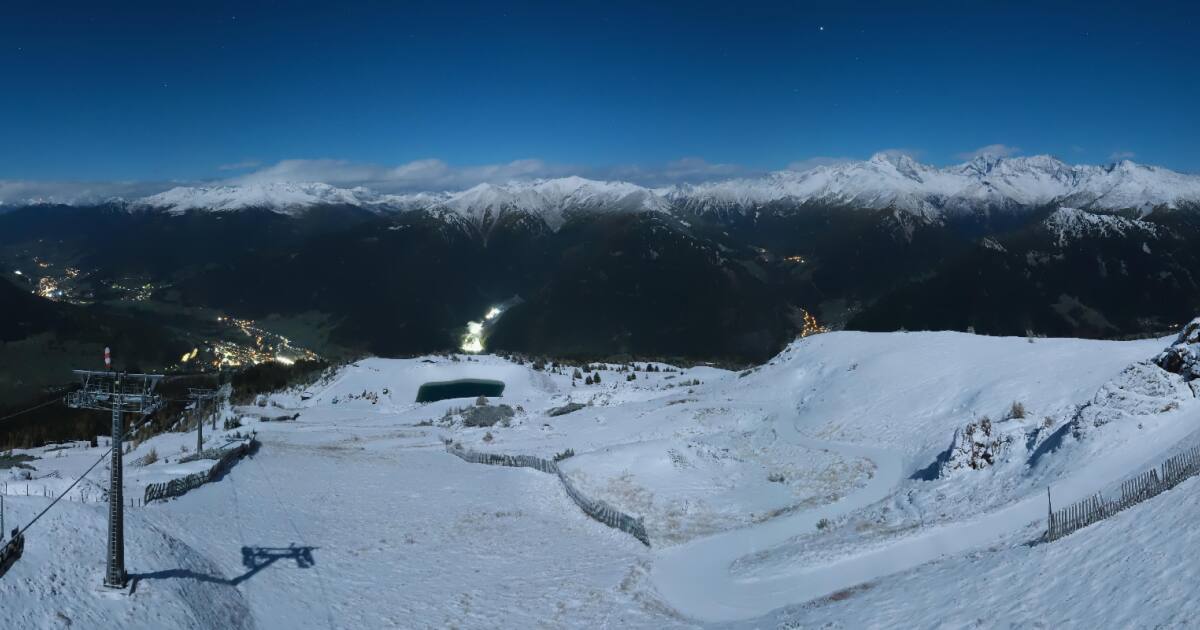
Above Steinach am Brenner, in the Wipptal valley of Austrian Tyrol, the Bergeralm offers a snowy holiday where skiing can continue well after dark. When the floodlights come on, over 9 kilometers of slopes come to life, and along the toboggan run, you can play in the snow even without putting on skis. The village lies beneath the mountain, at about 1.050 meters above sea level: Innsbruck is 26 kilometers further north, accessible by train, while the side valleys of the Wipptal offer landscapes to explore with snowshoes, cross-country skis, or sealskins.
The Bergeralm ski area boasts approximately 30 kilometers of slopes ranging from 1.048 to 2.231 meters. They’re compact in size, but offer long runs of varying difficulty, from blue to the black “Waldabfahrt.” Families can enjoy a ski school, a high-altitude introduction area, and childcare; more experienced skiers can alternate between the red runs and the black run, returning on open evenings. For a more varied vacation, Steinach allows you to combine the slopes with activities in the surrounding valleys and a visit to Innsbruck, without having to change accommodations.
Page sections
The slopes of the Bergeralm
The 8-passenger Bergeralmbahn gondola lift ascends from the village to the middle station, where the panoramic restaurant, learning area, and ski school meeting rooms are located. Other lifts include the Steinboden 4-seater chairlift and the Hoher Turm, a combined lift that alternates between cabins and 6-seater chairs. The ski area extends over a 1.100-meter difference between the lower and upper elevations: a space where shorter runs are combined with several kilometers of slopes.
The Sonnboden, a 4.300-meter blue run, is among the most interesting for those seeking a long descent without switching to the red runs. The Hochmahd and Gabi are also blue, measuring 2.300 and 1.500 meters, respectively. Therefore, skiers who are gaining confidence can leave the beginners’ area and continue on the blue runs, choosing the one best suited to their abilities with the instructor. Length, as well as difficulty, is especially important when skiing with children who are just starting out in the area.

Discover the best offers for a snow holiday in the best Alpine chalets and huts in the Dolomites, the best facilities immersed in the heart of the Dolomites with typical Alpine style.
Among the red runs, the 3.700-meter-long Nösslachjoch-Abfahrt stands out. Almost as long is the 3.500-meter Familienabfahrt: despite its family-inspired name, it’s a red run and requires good skiing ability. The Hohe Turm is 1.400 meters long, while the Manni Pranger is a 1.200-meter red. This variety offers intermediate skiers repeat runs to improve their technique and change routes without having to traverse a very large ski area.
The Waldabfahrt, a 2.000-meter black run, awaits those seeking a more challenging descent. It’s a must-see for those choosing the Bergeralm primarily for skiing, along with the long red runs: the offerings aren’t limited to children’s slopes, but the facility remains family-friendly. The Hochsonn lift, on the other hand, serves only natural snow slopes and opens when snow conditions allow.
The 2026/27 season is scheduled from November 28th to April 4th, with openings dependent on mountain conditions. Anyone planning to ski the Hochsonnlift should therefore check its condition along with that of the other slopes, especially at the beginning and end of winter.
Learning to ski and traveling with children
Noah’s Kinderland, the Bergeralm’s introductory ski area, is located next to the gondola lift’s mid-station. The gentle slope, dedicated slope, and moving walkways allow children to practice before moving on to the other slopes. Its proximity to the restaurant makes it convenient for breaks, while to reach the area, you must take the gondola lift: a return ticket is also required for those who only stay on the introductory slope. The two moving walkways, however, do not require an additional pass.
The Bergeralm Ski School of Sport Messner has an office and rental equipment at the valley station; courses are held at high altitude. Children aged 4 and above can participate in ski groups, while private lessons are available for children aged 3 and above. Group lessons are divided according to age and ability, so beginners don’t have to follow the pace of their more independent peers. The children’s program lasts up to five days, typically with 2.5 hours of lessons per day.
Even adults can start from scratch or resume after a long break: group courses last up to three days, with two hours per day, and private lessons are also suitable for those who want to perfect an already acquired technique. A family or small group can book a dedicated instructor, as long as the participants are of similar skill levels. Putting together a complete beginner and someone who already skis easy blue runs alone would not be the same.
Group snowboarding courses start at age 10; for younger children, the school offers private lessons. Skiing and snowboarding therefore have separate courses, depending on age and experience. The course fee does not include a ski pass or equipment, which can be rented at the lifts. Groups typically start on Mondays, with a different schedule during the Christmas holidays; for a short weekend stay, private lessons are a good idea.
Assistance at Bärennest
When children need a break from skiing, the Bärennest offers childcare in the Panorama Restaurant at the mid-station. It welcomes children aged 3 and up and offers lunch, allowing parents to continue skiing while the little ones take a break indoors.
In the 2026/27 season, the Bärennest is scheduled to be open from December 25th to March 31st, from Sunday to Friday, and also on Saturdays during the Christmas and Carnival holidays. From January 11th to February 1st and from March 1st to 31st, reservations are required by the day before. These are the times to consider when choosing a ski holiday with small children, as the service does not automatically follow the entire lift schedule.
Evening skiing and sledding under the spotlight
Evening is one of the reasons to choose the Bergeralm. Night skiing covers over 9 kilometers of floodlit slopes, spread across four runs: not just a short slope near the village, but a significant portion of the ski area. For 2026/27, the schedule runs from December 18th to March 6th, on Wednesdays, Fridays, and Saturdays, with facilities open from 6:30 PM to 9:30 PM and floodlights until 10:00 PM.
Evening ski passes are purchased separately from daytime and multi-day passes. The Panorama Restaurant is also open on those evenings, from 18:30 PM to 22 PM, for a high-altitude dinner between runs. The restaurant remains your base in the evenings as well; the cable car schedule is the key to planning your return journey.
The Bergeralm toboggan run is 5 kilometers long and is lit for night skiing. It’s an alternative for couples, groups of friends, and families who want to have fun in the snow without taking a ski lesson. To reach the starting point, you take the gondola lift: the operator strongly recommends this option because there is no separate path for walking up. Helmets are recommended for the descent, especially for children.
Staying in Steinach and stopping at altitude
Steinach am Brenner is one of the main towns in the Wipptal, with a train station and connections to Innsbruck, the Brenner Pass, and the side valleys. Staying here allows you to enjoy the slopes above the town and other leisure options. One of the most unique is the BBT Tunnelwelten, the visitor center dedicated to the Brenner Base Tunnel: interactive exhibits recount the tunnel’s construction, offering families an indoor visit that’s a departure from the usual afternoon on the snow.
Near the gondola base station is the JUFA Hotel Wipptal, which offers ski storage and family rooms. Those traveling with small children will find cots, high chairs, bed guards, and a play area. The free, covered wooden play area includes climbing facilities, a small bouldering wall, and a gym. It’s especially useful on rainy afternoons or when the kids need a change of activity.
The hotel itself features a Finnish sauna, infrared cabin, relaxation room, and fitness equipment. The sauna is also accessible to non-residents for a fee, so you don’t have to stay here to enjoy a wellness break. For a couple alternating skiing and relaxation, or for a group of non-skiers, having a service that can also be used by those staying elsewhere expands the possibilities of their stay.
On the mountain, the Panorama Restaurant, at the mid-station, offers local and international cuisine with self-service and a terrace. The same complex also houses 12 apartments: an alternative to staying in the village, close to the start area and mountain services. The Bärentraum restaurant offers table service and a sunny terrace for those who prefer a more leisurely lunch.
Hiking, snowshoeing, and cross-country skiing in the Wipptal valleys
For non-skiers, a vacation in Steinach can include the Bergeralm mountain and the valleys branching off from the Wipptal. Hiking requires travel from the village, by regional buses or car, but allows you to explore places beyond the slopes. The Wipptal winter network includes approximately 70 kilometers of hiking trails: some are designated Premium Trails and are recognizable by pink signs.
At the Steinach tourist office, you can borrow crampons and poles with a deposit, which is a plus when the trails are icy. Snowshoes, also available in children’s sizes, are available at the Steinach and Matrei offices. Poles can be borrowed free of charge with a guest card, again subject to a deposit. Those who prefer a companion can choose one of the Wipptal’s guided hikes, rather than planning their own snowshoeing.
Among the places worth exploring with snowshoes is the Nösslach plateau, in the Gries am Brenner area. The meadows and sparse larch forests offer hikes a different atmosphere than the slopes in the area, with winter trails also suitable for ski mountaineering. The Obernberg, Gschnitz, Schmirn, and Vals valleys offer additional itineraries of varying difficulty: the choice should be made based on the snow conditions and the group’s experience, especially when children are participating.
Cross-country skiing enthusiasts will find approximately 85 kilometers of free trails in the Wipptal, for both classic and skating techniques. Another 40 kilometers are in the Gschnitztal Valley, accessible from Steinach via Trins. This is one of the best areas for spending part of your holiday practicing Nordic skiing, offering a landscape and pace different from Alpine skiing. The Bergeralm Ski School also offers cross-country lessons and rentals, so you can try this discipline without leaving home with a second set of equipment.
Ski mountaineering on the Sattelberg and in the side valleys
The Sattelberg, the mountain in Gries am Brenner, is a former ski area that has become a popular destination for ski mountaineering. You can hike up to the refuge or continue toward the summit; there’s also a prepared area for the descent. It’s a separate destination from the Bergeralm, which can be reached by traveling toward Gries, and it’s one of the ways to explore the area with ski skins.
Other excursions take place in the Navis, Schmirn, and Vals valleys, between the Tux and Zillertal Alps, or in the Gschnitz and Obernberg valleys, on the Stubai Alps side. In Obernberg, the route must respect protected areas for wildlife protection. The avalanche bulletin, preparation, and self-rescue equipment remain essential; beginners can consult local guides. In the Wipptal, there are 15 ARTVA checkpoints, the avalanche transceiver used to search for victims buried in avalanches, and in Toldern, in the Schmirn Valley, there is a practice area for searching with a device, probe, and shovel.
How to get there and get around
The S3 train line connects Innsbruck to the Brenner Pass via Steinach. From the station, you can reach the Bergeralmbahn station with bus 574, which continues towards Trins and Gschnitz. Bus 560, coming from Innsbruck via Patsch, Ellbögen, and Matrei, also stops at the lifts. It’s therefore possible to arrive by train and reach the slopes by public transportation, taking into account the connection times.
The Wipptal Card, provided by your accommodation, includes regional public transportation by bus and train. Before your trip, you can request a voucher from your accommodation for the journey from Innsbruck or the Brenner Pass, so you can use it before checking in. Buses from the valley stations also serve the surrounding villages: if you’re planning a hike, it’s a good idea to check the outward and return fares together.
By car, you can reach it via the A13 Brenner motorway, exiting at Matrei/Steinach, or along the B182 road. The cable car departs from Steinach, with direct access from the village.
Innsbruck Airport
Innsbruck Airport is the closest airport to the Bergeralm by plane. Airport transfers to the Wipptal are available; those who prefer public transportation should reach Innsbruck station and continue by train to Steinach, or use the bus connections to the valley. The choice between transfers and public transportation depends on the flight schedule, luggage, and location of your accommodation, especially when traveling with children and ski equipment.


There are no comments