









Elm, in the Swiss canton of Glarus, preserves a cluster of wooden houses and offers a snowy holiday including skiing, cross-country skiing, and hiking. Schools cater to both children and adults, while the old schoolhouse houses a museum and visitor center.
Page sections
A wooden village under the Tschingelhörner
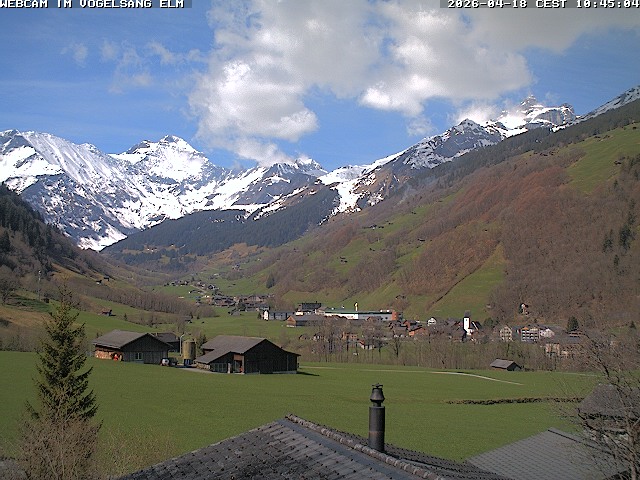
Elm is the last village in the Sernftal, the valley that extends into the Glarnerland, the territory of the Swiss canton of Glarus. Situated at around 1.000 meters above sea level, it is primarily a village of wooden houses. Precisely for the preservation of these houses, it received the Wakker Prize in 1981, the Swiss award for attention to the built environment.
Above the village rises a jagged ridge, the Tschingelhörner, instantly recognizable from Elm. The Martinsloch, a large natural window, opens up in the rock. It wasn’t carved out by a single event: two weak points in the rock intersect here, and erosion worked faster than elsewhere, eventually piercing the face. The terrace of the Munggä Hüttä, a mountain hut and restaurant in the ski area, overlooks this ridge; the village visitor center helps visitors learn about its geology.

Discover the best offers for a snow holiday in the best Alpine chalets and huts in the Dolomites, the best facilities immersed in the heart of the Dolomites with typical Alpine style.
Elm’s slopes and the choice of return
The resort offers 40 km of alpine ski slopes. The gondola lift connects the valley station, at 1.020 m, to Ämpächli, at around 1.480 m. This is followed by the Schabell and Pleus chairlifts, at 2.036 m, respectively, and Steinböden, at 2.105 m, the highest point served by lifts. With the Bischof and Ämpächli ski lifts, the network includes five main lifts.
Among the descents are the Rietboden, number 8, blue, and the Vreni Schneider, number 10, red: the latter bears the name of the champion from Elm, to whom a ski school, a rental shop and the village museum are also linked.
The return journey requires caution: Stalden is red, Steinibach is black overall, with a final stretch of blue. Before descending to the village, it’s important to assess your ability on red or black runs and check whether they’re open.
The FUTURO project has been announced for the 2026/27 season, which includes technical snowmaking on approximately 35% of the slopes, in addition to a ski run and a sledding run down to the valley. This project also includes the lower-altitude slopes, where those returning to the village on skis or sleds end their day.
Learning to Ämpächli, as children and as adults
The Ämpächli Kinder Arena is the area for beginners on skis and snowboards. It has three moving walkways, which are conveyor belts that you climb onto while standing, and a ski lift for learning to ski. It’s located next to the cable car arrival point, so children are close to the restaurant and the adults waiting for them.
The two ski schools offer courses with different formats and entry ages. The Schweizer Ski- und Snowboardschule Elm, the Swiss ski and snowboard school, offers group ski lessons for children, divided by ability. Beginners learn to brake and turn, while experienced skiers work on their technique and try more challenging slopes. The starting level is determined by the school.
Snowli-Kids and the course with a parent
For the youngest children, the Swiss school organizes Snowli-Kids, a weekend course in the Kinder Arena, open to children aged four and up and available when the facilities are in operation. It involves a real separation from the parent. Parents accompany the child to the meeting point and hand them over to the instructor, then pick them up in the Kinder Arena. Therefore, a certain amount of autonomy is required: the child must understand simple instructions and wait for brief moments without their parent nearby.
In the snow garden, as the Swiss school calls the first exercises area, the program progresses in stages. Children begin by walking with skis on their feet, then learn to slide and brake like a snowplow, then learn to turn, and finally do exercises with small obstacles to overcome. Advancing to the next stage depends on what the child already knows, not on a fixed number of lessons.
The Vreni Schneider school offers a different approach: a parent-child course for children between the ages of two and five. Here, an adult participates in the lesson alongside their child, in the Ämpächli area. The lessons focus on movement, gliding, and initial stops. It’s a great option for those whose children are too young for Snowli-Kids or aren’t yet ready to be left alone with an instructor.
The first time as adults
Adults can also start with a private ski or snowboard lesson. The Swiss school offers a one-time introductory program for adult beginners. It includes two hours of private lessons, full-day equipment rental, and a day pass valid for the beginner area. This day pass doesn’t open the entire ski area; it’s a great way to practice where you’ve learned. Those who want to try the blue slopes at higher altitudes can purchase a separate ski pass.
For equipment, there’s Vreni Schneider Sport, the shop in the center of town. In the winter, it rents skis and snowboards, including children’s sizes, boots, helmets, snowshoes, and cross-country skis for classic or skating techniques. Anyone wanting to try a different model can reserve skis for the test service and pick them up at the location opposite the cable car valley station, which is not the same as the shop in town.
Snowboarding and working on technique
The board has its own learning path. The Swiss school offers group snowboarding lessons for children: beginners gain confidence on the board, learn to stop, and make their first turns; advanced riders improve their technique and become accustomed to confidently descending more challenging slopes.
For those who already ski well and want to work on their precision, the Vreni Schneider school has a section dedicated to racing technique. Upon request, timed trials, station exercises, and video analysis are available, allowing you to observe your skiing in racing conditions and correct it with the help of an instructor. It’s also an option for those looking for something beyond a traditional advanced lesson.
The Elm Trail between houses and woods
Cross-country skiing stays low down, between the houses. The Elm Loipe is route 230 of the SchweizMobil network: it starts and ends in the village and is about 8 km long. The first section, called Wiese, is almost flat and passes by the houses in the village.
After the bridge, the trail changes character. The Bärentritt begins, the steepest climb of the entire loop, and once at the top, the trail continues along the edge of the forest towards Aeschen. Those with little cross-country skiing experience can start with the Wiese section. The entire loop, however, is not entirely easy, and the Bärentritt should be factored in before setting off.
Equipment can be rented in the village, at the same shop that serves alpine skiers, for both classic and skate techniques. Before heading out, it’s a good idea to ask which technique is currently available on the trail.
Winter walks and sledding from Ämpächli
Even for non-skiers, Ämpächli is the starting point for snow-based activities: from the cable car station, you can embark on winter walks on groomed trails, without the need for snowshoes. The shortest hike takes you to Älpli, a mountain hut just above the top station, in about fifteen minutes.
Those who want to hike further can continue along the Älpliweg, past the Älpli, and reach the Munggä Hüttä, the refuge and restaurant in the heart of the area. It takes a good hour one way. The return journey is calculated separately, depending on your pace and remaining daylight.
4 km sled ride to the village
The toboggan run begins next to the mountain station and descends for 4 km to the Elm station. It is separated from the roads open to cars and is groomed during winter operation.
Those who don’t have a sled can rent one at the ticket office at the valley station or at the Ämpächli restaurant. On some scheduled evenings, the sled is open with the lights on: you can ride up in the dark by cable car and ride down under the lights. Opening times, both day and night, depend on snow and weather, and the evening schedule and tickets must be checked in advance.
Refreshments and evenings bookable above Elm
At high altitude, rest stops vary. The Bergrestaurant Ämpächli, next to the mountain station, is a self-service restaurant with a terrace, perfect for a simple break between runs or at the cable car arrival: a buffet of salads, spaghetti, chips, and seasonal dishes.
The Älpli, on the other hand, has the feel of an alpine hut. From the terrace, you can look out over the surrounding mountains, and seasonal specialties include homemade Kaiserschmarrn. The Munggä Hüttä is the refuge where you can enjoy mountain cuisine: rösti, alpine spätzli, fondue, and raclette. Its terrace overlooks the Tschingelhörner.
Two evening options offer a full program of activities and should not be confused with a self-guided dinner. Winterzauber, at Munggä Hüttä, is available for groups of fifteen or more. It includes a cable car ride, a guided snowshoe hike to the hut, dinner, and a sled ride back down to the valley, with snowshoe and sled rental included.
Hüttenromantik takes place at Älpli. You take the cable car up, walk to the hut along a lit trail, have dinner, and then sled back to town. Individual reservations are also possible, but the evening will only take place if there are at least twelve people registered. Neither option is open every evening without reservations.
Staying in the country
Hotel Elmer is located in the protected core, in a building constructed in 1858. It has twenty rooms and a sauna area, accessible by reservation even to guests staying elsewhere. Those who choose an apartment or other guesthouse can therefore enjoy a sauna break without changing accommodations, as long as they book.
The Hotel Segnes is located just above the church and is designed for large families: in addition to double rooms, it offers rooms for three, four, and five people. It also has a room for drying shoes and clothes.
Those who prefer to cook for themselves can stay in the Suvorowhaus, one of the village’s historic houses. The attic features a furnished studio with a kitchen, double bed, and sofa bed, sleeping up to four people. The house’s name comes from an episode from 1799. Russian General Suvorov spent the night there before crossing the Panixer Pass with his army in October.
The Old School and the Blackboard Factory
The old schoolhouse on Sandgasse houses two distinct institutions, each with its own hours and rules. The Vreni-Schneider-Museum traces the career of the champion who left Elm, with medals, cups, Olympic jerseys, and personal stories from Vreni Schneider herself. A section is dedicated to mental strength. Hours should be checked before visiting.
In the same building, at Sandgasse 1, is the Sardona Visitor Center, which explains the mountain from the village. It features a 3D model of the area, tables with tools and games, a reading area, and games inspired by Martinsloch, suitable for children as well. The center is open daily and, upon request, organizes visits with a GeoGuide, a guide specializing in the geology of the area.
The center’s theme is the Tektonikarena Sardona, a UNESCO-listed geological landscape. Here, the Glarus thrust line reveals older rocks pushed over much younger layers during the formation of the Alps, contrary to the usual order. At the center, it’s also clear why the Tschingelhörner ridge is of such interest to geologists.
A little further on, the Schiefertafelfabrik illustrates the village’s work. The name means slate blackboard factory: Schiefer is the slate, Tafel the blackboard. Founded in 1898, it primarily produced school blackboards, but also other small objects, through more than thirty different processes. The guided tour lasts about an hour and a half. It displays the old machinery and links the slate production process to the history of quarrying and the landslide that struck Elm. It is not a freely accessible museum: groups are organized with the manager, who is also available to ask if it is possible to join an existing group. In winter, the group visit can be combined with a meal in the village and, upon request, a guided tour of the village.
Getting to Elm from Zurich Airport
The nearest airport is Zurich Airport. From there, a train takes you to Zurich Hauptbahnhof in about fifteen minutes. Those fifteen minutes only apply to this first leg, not the entire journey to Elm.
From Zurich, take the S25 to Schwanden, where you transfer to the valley bus. It’s a good idea to check the schedule for your travel date. Before boarding the bus, you need to know where to get off. Those staying in the village center get off at Elm Dorf, the stop near the church. Those going directly to the ski slopes or who have booked near the lifts continue to the Elm-Ämpächli cable car valley station.
By car from Zurich city, it takes approximately an hour, but this can be longer if there’s snow. At the valley station, there are parking lots and four charging points for electric vehicles.


There are no comments