







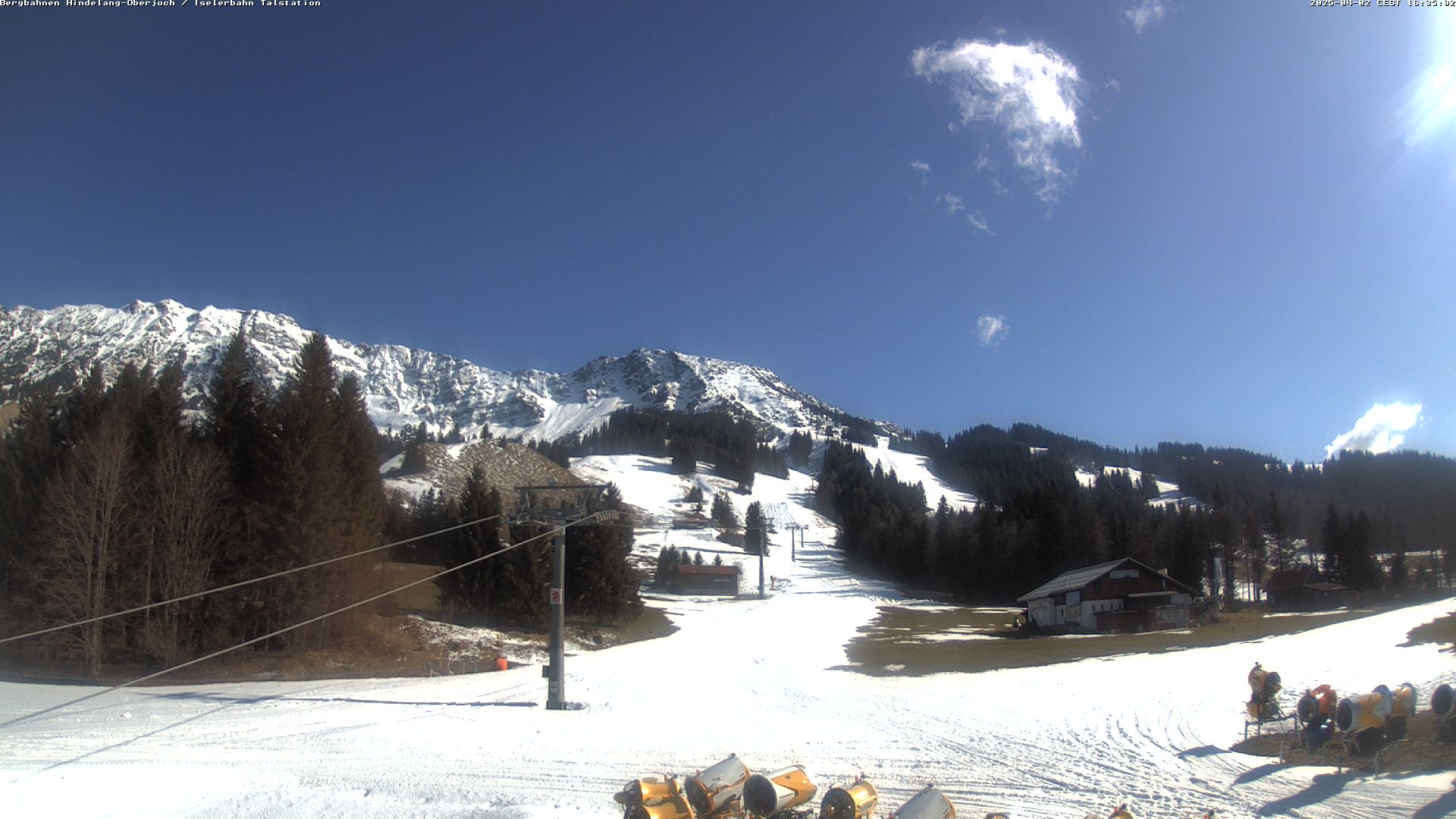
Oberjoch is located in Bavaria, in the Allgäu Alps of Germany, on a plateau above Bad Hindelang. The Joch Pass road climbs from the valley floor in a long series of curves up to the houses, around 1.150 meters above sea level. The village, with about 400 inhabitants, overlooks the slopes of the Iseler and Kühgund, the mountains at whose foot the slopes unfold. From the village, you can see the chairlifts, practice slopes, and slopes.
It’s a great place to learn to ski, travel with children, and enjoy a relaxing stay in the snow. The red runs are still numerous, giving experienced skiers the freedom to change routes, but the offerings focus heavily on beginners: small lifts, a large children’s area, and schools offering courses for adults as well. The afternoon continues at hotels with spas, restaurants, or with a walk on the plateau.
The location also allows you to explore the Bad Hindelang area and the nearby Tannheimer Tal, a valley in Austrian Tyrol. The valley widens towards the border, while descending into Bad Hindelang leads to the toboggan runs served by the Hornbahn ski lift. These excursions can be alternated with skiing at Oberjoch, organizing transportation from your accommodation and choosing the activities that are actually open during your stay.
Page sections
The slopes above the village
The Oberjoch ski area offers 32 kilometers of slopes, served by four chairlifts and the Idealhang ski lift. The Grenzwiesbahn, Wiedhagbahn, and Iselerbahn chairlifts each seat six; the Schwandenbahn seats eight. The lifts are connected by the slopes, so those with the necessary skill level can move between the different areas without having to return to the parking lot each time.

Discover the best offers for a snow holiday in the best Alpine chalets and huts in the Dolomites, the best facilities immersed in the heart of the Dolomites with typical Alpine style.
The highest climb is the Iselerbahn, which reaches 1.559 meters. The Wiedhagbahn reaches 1.465 meters, and the Grenzwiesbahn 1.420 meters. Above this are the peaks of the Iseler, at 1.876 meters, and the Kühgund, at 1.907 meters. Skiing with the lifts takes place on the lower slopes of the mountains, with a more modest elevation gain than their summits suggest.
From the blue ones of Schwanden to the red ones of Iseler
The Schwandenbahn and the Idealhang ski lift serve the blue runs near the village. The Schwanden and Idealhang, along with the blue Zubringer, are ideal for those learning or wanting to stick to less challenging slopes. Its proximity to the village and the practice areas makes this part of the resort a good choice for skiing with children who aren’t yet ready for the red runs.
Going up the Iselerbahn, you reach the Standard, Damenhang, and Waldschneise runs, all red. Toward the central section, the Wiedhagbahn serves the red Wiedhag Osthang and Wiedhag Steilhang runs; closer to the Tannheimer Tal side, the Grenzwiesbahn offers skiing on the red Grenzwiesen, Kühgund Ost, and Kühgund West runs. For an intermediate skier, variety lies in switching between the different runs, choosing runs of similar difficulty.
Black run number 11 belongs to the Alpine Training Center Allgäu, the Alpine skiing training center. Its availability depends on the center’s activity; it should not be considered a constantly accessible descent for the public. For more experienced skiers, there are also routes such as Wiedhagalpe and Steilschneise, classified as black ski routes, but not on the groomed slopes.
Ski routes are marked ski routes where the surface is not groomed like a normal slope. In Oberjoch, they also include Wiedhagtrasse, Iselerkar, and Ochsenalpe, indicated in red. They are identified on the map by the diamond symbols and dotted lines; navigating them requires the appropriate skill level for the snow conditions and checking whether the routes are open. Ski area regulations and local restrictions must still be respected even when a route appears on the map.
The snowmaking system covers several slopes in the Idealhang, Schwanden, Iseler, Wiedhag, and Kühgund areas. Before heading out for a ski trip, the bulletin allows you to see which slopes and lifts are open. It’s especially useful when you’re traveling for a few days and want to use a specific area for lessons or the slopes of a specific chairlift.
Learn to ski at Kinderland
At the base of the Iselerbahn is the Ziener Schneekinderland, the Ostrachtal Ski School’s introductory area. It covers 20.000 square meters and features two small cable cars and two magic carpets. A snow carousel, igloo, train, and mascot Isidor’s playhouse complement the exercises; small slaloms, bumps, and jumps help children gain confidence on skis in a dedicated area.
For children aged 3 and 4, the school offers a two-hour introductory lesson, with the option to continue if they enjoy the experience. For children aged 4 to 12, there are group lessons, organized by level. Training begins with equipment, moving on flat terrain, braking with a snowplow, and the first ascents; once these skills are mastered, lessons continue on the blue and then red slopes, continuing the learning process.
The Kinderland has its own artificial snow system and is managed separately from the resort’s facilities. The standard ski pass does not include access: admission is free for Ostrachtal school students and Bad Hindelang Plus card holders, while other visitors pay a fee. It can also be visited without a course, by arranging access with the school.
Beginners aren’t just for the little ones. The school offers lessons for teenagers aged 13 to 18, adults, and those returning to skiing after a long break, as well as private lessons. A beginner adult can start in the blue areas near the village, working on braking and turning before seeking out longer runs. The layout of the Oberjoch slopes allows for a tangible progression, from the learning slopes to the slopes served by the upper chairlifts.
Snowboarding and Easypark at Idealhang
Snowboarding can be learned at the Ostrachtal School, which offers group lessons for ages 7 and up, as well as lessons for those with experience. The program for advanced students may also include freestyle skiing, while beginners focus on board control and use of the lifts. The four main chairlifts offer access to the wider slopes without having to rely solely on the ski lifts.
The Easypark is located at the top of the Idealhanglift. When snow conditions allow, the course includes waves, a parabolic curve, and a small jump: it’s a great way to learn the fun elements of snowboarding and skiing. The layout depends on snow conditions, so it’s worth checking before choosing Oberjoch for a freestyle-focused vacation.
Cross-country skiing on the plateau and winter walks
The Hochmoorrunde is one of the local cross-country ski trails: it’s 1,95 kilometers long and features approximately 10 meters of elevation gain. Its short length allows you to dedicate time to practicing your technique without immediately committing to a long route. The Ostrachtal ski school offers private lessons for ages 7 and up, by appointment, for classic technique, skating, and Nordic Cruising.
The cross-country ski trail continues beyond Oberjoch in the Bad Hindelang network, with connections to the Tannheimer Tal and Jungholz in Austria. This totals approximately 90 kilometers of groomed trails for classic and skating. Those looking for longer excursions can choose from several locations, while beginners are especially interested in exploring the loop near their starting point.
On Thursdays, there’s an evening cross-country ski run at Oberjoch starting at 5:00 PM. The trail isn’t lit, so a headlamp is required. Another option is in Bad Hindelang, near the Hornbahn, where there’s a 1,5-kilometer lit trail. Again, check whether the trail operates in the evening and is in good condition for your chosen date.
The Alpsteigtobel ring
For winter hiking, consider the Alpsteigtobel, a small wooded gorge reached by a circular route starting from Oberjoch. The winter trail is 8,1 kilometers long, takes approximately 2 hours, and features a 140-meter elevation gain. From the plateau, you pass through Untere Schwande and across meadows toward Unterjoch, then reach Krummenbach and enter the gorge near the chapel.
The trail ascends through the forest to the former customs building, crosses the pass road, and returns to Oberjoch on wider sections. Snow and ice can make the narrow sections challenging: check conditions before setting out and, if necessary, use crampons and poles. The length and the section through the gorge require careful planning if hiking with children.
Those who prefer snowshoeing can book an excursion with the Ostrachtal School, letting the guide choose the route based on the group and the snow conditions. The area also offers introductions to ski mountaineering in the Bad Hindelang Plus program, between December and March, with advance registration. For those who want to improve their technique in fresh snow, the school offers specific courses that also address the dangers to be considered off-piste, including avalanches.
Sledding at the Hornbahn and other outings in the surrounding area
In Bad Hindelang, lower than Oberjoch, the Hornbahn serves two 3,5-kilometer toboggan runs. The blue run is family-friendly; the yellow one has many curves and requires more skill. Toboggans can be rented at the lower station, while the opening of the runs depends on snow and condition.
The ascent takes you to 1.320 meters, overlooking the Ostrachtal, the valley between Bad Hindelang and Hinterstein. At the upper station, you’ll find the Zum Oberen Horn restaurant, with a panoramic glass veranda and regional cuisine. The Hornbahn is therefore also a worthwhile excursion for a winter hike and a break at altitude, with arranging a transfer from Oberjoch to the valley floor.
Unterjoch is a nearby resort with its own ski area, separate from Oberjoch and served by three ski lifts and two introductory lifts. It has schools and rentals and may be of interest to those looking for another option for their first descents.
Hotels, restaurants and services for families
On the slopes, the Wiedhagalpe is the refuge near the Wiedhagbahn chairlift arrival point, about 150 meters from the upper station. It opens on lift operating days and is a great place to stop during your ski trip without returning to the village. Further down, the Oberjoch hotels offer a range of dining and wellness options, also useful for those who want to spend part of their holiday without skiing.
The Panoramahotel Oberjoch offers double rooms and suites with balconies or terraces. The Alpin-SPA extends over 3.000 square meters, with indoor and outdoor pools, saunas, a salt room, relaxation areas, and treatments. Dining options include the Panoramarestaurant, the Chaletrestaurant 1200 NN, and the Wasserstrudel bistro; the three-quarter board option includes a six-course dinner. The Freiluft bar offers an additional place to relax in the evening, without leaving the hotel.
The Oberjoch Familux Resort, on the other hand, is designed specifically for children. Childcare is organized by age, from newborns to toddlers aged 1 and 2, with a mini club for 3-5 year-olds and a group for 6-9 year-olds. The hotel offers its guests baby equipment on loan, meals suitable for the little ones, and indoor play areas. The pool area offers activities for different ages, along with saunas and relaxation areas for adults.
What does Bad Hindelang Plus include?
The Bad Hindelang Plus Card is available from participating accommodations, recognizable by the Plus symbol when booking. In winter, it includes a ski pass for the Oberjoch lifts, access to the Kinderland, and uphill and downhill rides on the Hornbahn, depending on service availability. The number of days of use corresponds to the number of overnight stays; individual activities follow their own timetables and calendars.
Options also include admission to nearby swimming pools: four hours at the Wonnemar in Sonthofen and three hours at the Alpspitz-Bade-Center in Nesselwang, both without access to the saunas. The program of experiences includes visits to an alphorn maker and cooking classes for Kässpatzen, the Allgäu cheese dumplings. In winter, visits to an organic farm are also available on selected dates. Advance registration is required for these activities, so you don’t have to rely on a daily appointment to arrive.
How to get there and get around
From the A7 motorway, exit at Oy-Mittelberg and continue for about 20 kilometers on the B310 to Oberjoch. Those arriving from Sonthofen and Bad Hindelang instead ascend the Joch Pass; from the Austrian Tannheimer Tal, follow the B199. Parking is paid at the Iselerbahn and Wiedhagbahn stations, while there are free parking spaces at the Grenzwiesbahn entrances.
The nearest train station is Sonthofen. From there, take the bus to Bad Hindelang and Oberjoch; line 48 also continues to Jungholz and Wertach. Guests staying overnight in the area receive the MOBILPASS ALLGÄU in their guest pass, valid for transport within its area. It can be useful for travel without a car, but it should be differentiated from the Plus pass for participating establishments.
Airports for a holiday in Oberjoch
The airports to consider are Memmingen and Munich. After your flight, you can continue with a pre-booked transfer or organize the journey to Sonthofen and complete it by bus, checking connections and the last available bus to the plateau.
The Oberjoch Familux Resort organizes airport transfers upon request. Guests must contact us at least 48 hours before arrival or departure, providing their flight number and arrival time. Those choosing another accommodation can arrange a taxi or check on the property’s amenities, especially if traveling with small children and ski equipment.


There are no comments